Liver and onions - ugh?
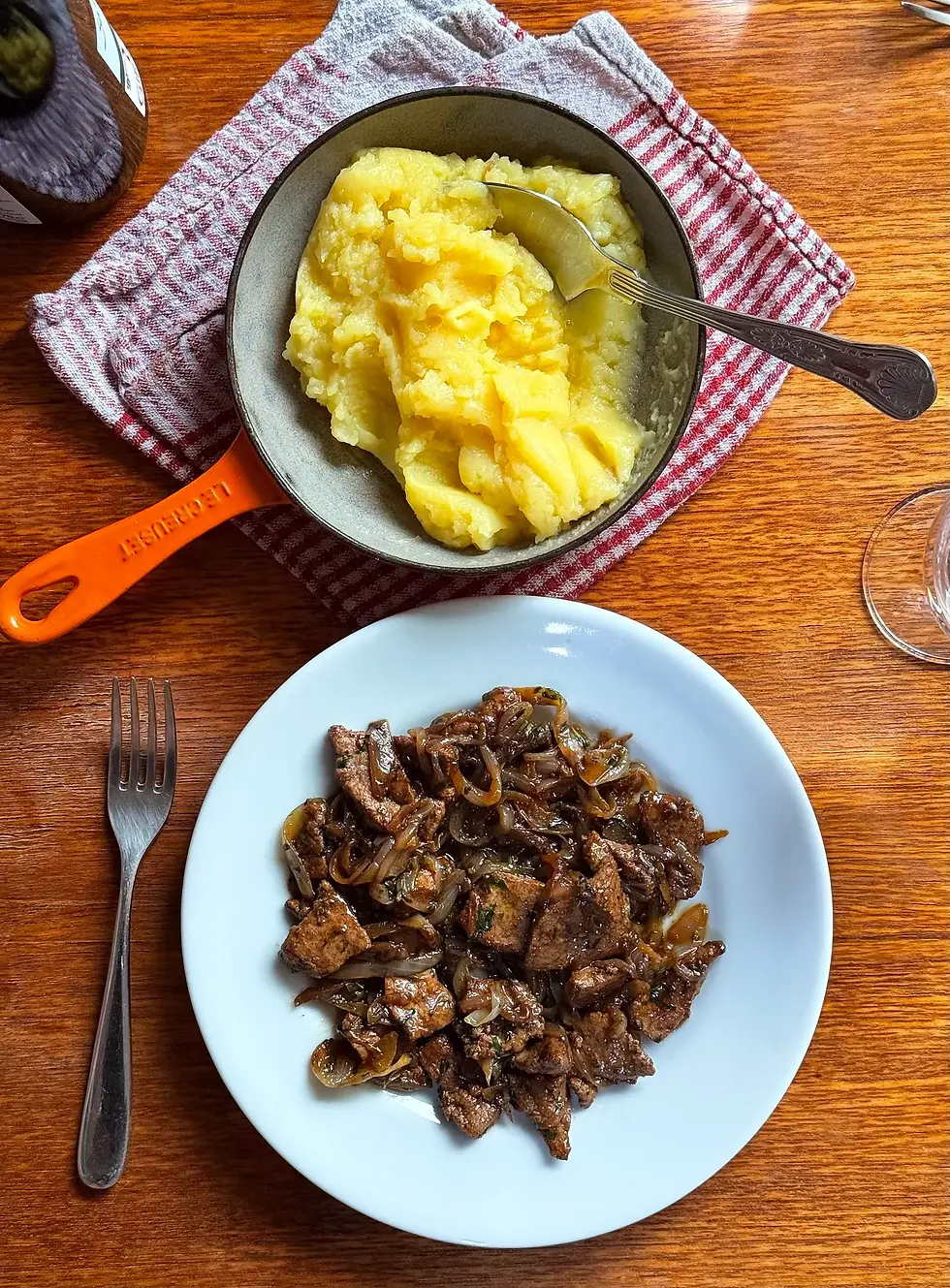
"There is rarely a middle ground with liver. Either you've turned the page already, or you're a devotee who gets excited about the idea of the exceptionally savoury exterior of a piece of flash-fried or chargrilled liver and its almost jelly-like flesh." Nigel Slater
So true, and I'm willing to bet that when you see that title, signalling that this post is about liver, you will go no further.
But I'm going to be true to my lucky dip rules, for this is a lucky dip post. Randomly pick a book from my cookbook shelves - now done by David, because even with my eyes closed I sort of know what I'm picking, so it's not entirely random. He has no idea even if he can see the books. But I do randomly pick the page.

This time he picked out Roger Vergé's now ancient Cuisine of the Sun, which I think has been picked before, but never mind - the page is different. A recipe for Calves liver with radishes and turnips - turnips too - another unloved ingredient. There is no picture and no recipe to be found online, and it's pretty long, so frankly I'm going to ignore it.
However, before abandoning his book and his recipe completely I reread his Foreword, and herewith give you some of his words, which are amazingly modern in the sense that recipes of his time were meant to be followed as written (well at least that's what many of us thought), and here he is telling us to improvise and do our own thing:
"A recipe is rather like a piece of music. although the notes may be read and reproduced faithfully the result can still be crude, mechanical or just uninteresting. ... One never makes a recipe in precisely the same way for two days running. ... If a recipe is a musical composition, it is you who must give it voice. A cook is creative, marrying ingredients in the way a poet marries words, combining flavours, and inventing new and subtle harmonies.
A recipe is not meant to be followed exactly - it is a canvas on which you can embroider. improvise and invent. Add the zest of this, a drop or two of that, a tiny pinch of the other. Let yourself be led by your palate and your tongue, your eyes and your heart. In other words, be guided by your love of food, and then you will be able to cook."
Somehow rather old-fashioned in style but nevertheless exactly the sort of thing that Nigel, or Jamie or Ottolenghi or any number of recipe writers of today would say in their own inimitable styles.
Speaking of old-fashioned - in my childhood and youth we would sometimes be served liver and bacon - and there were probably onions in there too, and I must have liked it sufficiently to actually cook it for my new husband a few times as well - often with the addition of spinach - Roger Vergé is so right about no recipe ever being cooked the same twice. David ate it and I don't remember him complaining - but it was early days. We never have it now. And indeed I think the only kind of livers you will find in a supermarket these days are chicken livers. In spite of the vast number of Italian migrants and their descendants in this country offal is not to be found in supermarkets - where most of us shop.
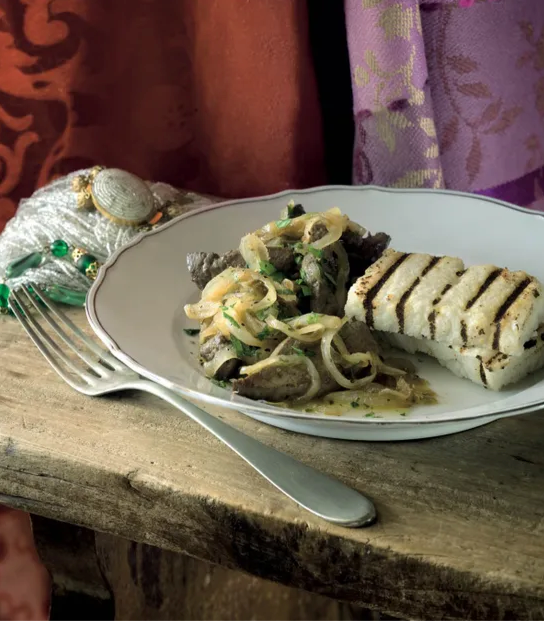
But back to Fegato alla Veneziana in a very oblique attempt to stick to my lucky dip rules. The fact that it was liver reminded me of my recent post on Tessa Kiros's book Venezia which includes this recipe for Fegato alla Venezia. Well I guess you can't write a book about the food of Venice without including the recipe. But alas it's not online. So I decided to do a post on this particular dish and try and find the real deal. So why is it so famous? Well Nick Bramham, writing in the Vittles Magazine tells us:
"In its purest form, fegato alla veneziana comprises thin strips of calf’s liver that are quickly sautéed with local Chioggia onions, hit with a splash of white wine or vinegar and slid onto a plate. When cooked well – with thoughtfully sourced and prepared ingredients and a short rest to let the juices mingle – this evocative, transportive dish is an immensely satisfying and comforting plate of food, a delicious interplay between the tender, lightly-frazzled-but-still-blushing-pink liver, the gentle savouriness of caramelised onions and the sweet and sour jolt of good-quality vinegar." Nick Bramham/Vittles
That's a picture of his recipe at the top of the page, but alas, not being a paying subscriber to the newsletter in which it is contained, I cannot access it.

Nigel Slater is also a fan:
"Flash-fried liver married to slow-cooked onions is so irresistible it'll tempt even the most squeamish" Nigel Slater
and he tweaks the recipe a bit by adding oranges - Lamb's liver with onion and Seville orange relish/The Guardian
I have a lot of Italian cookbooks, and so I decided to look at some of them to find, maybe, the quintessential recipe. Well I found a couple in addition to the one from Venezia - pictured here - but, again, no recipes online: from Guy Grossi and Lorenza de' Medici in Italy the Beautiful Cookbook. In Italy it's most often served with polenta - either soft or fried, but elsewhere it's often served with puréed or simply mashed potatoes. Mind you today we may well have reverted to polenta - it's pretty fashionable.
During my search for an 'authentic' recipe I found this one for Fegato alla Veneziana from Travel Gourmet, the writer of which dedicated it to Antonio Carlucci who had just died. He/she also mentioned that they could not find Carlucci's recipe in those of his books that they owned - and you won't find it online either, but he did say that he/she resorted to Rick Stein - whose recipe for Fegato alla Veneziana from his book Rick Stein's Food Stories - is online, although there it's called Pan fried liver and bacon. I also don't think it's the same recipe as our man or woman the Travel Gourmet made. Rick Stein has balsamic vinegar - and that bacon - which is not authentic and which does't feature in the Travel Gourmet recipe. But then that author, in the spirit of Roger Vergé tells us "It was a little hit and miss as usually I don’t weigh anything and just throw it together last-minute"
I suspect that not a single one of my readers is actually going to try cooking calves liver and onions the Venetian way - or any other way for that matter. However, it is indeed such an important dish for Venice - some would say the official city dish - that it's worth at least looking at and wondering why?
It's therefore a little ironic, that just as I was going to close this post I decided I really should find out more about its origins and found on the website Colosseum and Vatican Tours, along with a Traditional Recipe for Fegato alla Veneziana, which I have to say looks pretty good, these words:
"Fegato alla Veneziana has ancient origins, dating back to Roman times. Even then, liver was considered a delicacy, but to mitigate its strong flavor, the Romans cooked it with figs. The term “ficatum,” used to describe this preparation method, evolved linguistically to become “fegato” in the Italian language.
With the rise of the Republic of Venice, the recipe underwent a significant evolution. Instead of using figs, Venetians began cooking liver with onions, a more accessible, economical, and widely used ingredient in lagoon cuisine. The combination of liver and onions proved to be a winning one, creating a dish that became a true symbol of Venetian cuisine."

Or you can try this recipe from our own Phoebe Wood on the SBS website, which looks pretty good - and simple.
Or visit one of our very excellent Italian restaurants and try it there - well check that they make it. Maybe the Veneto Club does.
YEARS GONE BY
August 5
2025 - Nuggets
2024 - The joy of meatballs - coincidence - we're eating the leftover meatballs from Sunday's birthday feast tonight.
2023 - Nothing
2022 - A quickie on baskets
2021 - Missing
2020 - Missing
2019 - Nothing
2016 - Paris Go


Comments