Drops
Drop: "single globule of liquid; small amount of anything"
They can be fruit drops too - it doesn't have to be just a liquid. It's funny how almost any of the words I have chosen for these oddments posts have some kind of foodie connection. In this case many - a drop of any kind of liquid you might add to what you are cooking, which might be as vague as a little bit, or as in the case of something really strong like tabasco, or food colouring - literally just a drop - or two. And then there are fruit drops - as shown above, a kind of sweet or lolly if you are Australian, or confectionery if you are a bit posher. Apparently they were invented in the mid nineteenth century, when somebody produced a machine that could shape them. Boiled sweets like barley sugar were all the rage - and they were also used as medicine too. Maybe they were hoping to fool children into thinking they were getting a sweet not medicine.
So here I go with a few little things, which I suspect will be mostly recipes I have noticed here and there and thought I might make some time. Although I probably won't. You see it's late in the day, and I am uninspired.

Somehow or other I came across this - I can't imagine that it was a recent item in the Guardian Feast newsletter as it says the article is over 12 years old, but anyway - prickly pears - a pest in Australia - which can apparently be turned into this sorbet :
"a revelation. The taste is floral, reminiscent of watermelon, but really it’s a flavour all of its own. It’s like sunshine, both the colour and the taste are so bright." Romy Ash/The Guardian.
But beware if you come across any in your neighbour's back yard because:
"Be very careful handling the prickly pears. This is one fruit that should not be poked and prodded at the market. The spines are virtually invisible and very difficult to remove from your hands. Do not hold them with your bare hands, and make sure they are in a secure bag from the market. To remove prickles from the fruit, hold the prickly pears with tongs, place the fruit under cold running water and scrub them with a brush. The little points, where the prickles are, will go white once the prickles are removed. Once they’re out you can hold them without fear."
It's enough to put you off really, but I guess if you find it on a restaurant menu anywhere it might be worth a try. I wonder why the very first people to try and eat this fruit persevered. They wouldn't have known how to remove those spines after all and it would have hurt - maybe even made them very ill.
Some scrumptious roast potatoes
Before I really got into cooking I used to make roast potatoes the same way my mother did. The first point being that I and my mum - only made them when we were having a roast of some kind. The potatoes were par-boiled - well boiled until the water was boiling, which I recognise is a bit of a non sequitor - but you know what I mean. They were drained and put into the same roasting tray as the meat which had been cooking for a while and so the fat was hot. They were turned around so that they were covered in fat and then left to cook until brought to the table where we all fought over them. As far as I knew this was the only way to do it, Well my grandmother, and therefore my mother sometimes, also used to roast some separately in shallow water which gave them quite a different texture - sort of semi-mashed on the bottom and almost crispy, but more smooth, on the top. But we still loved them.
I continued to cook them my mother's way for years and years, although along the way I picked up that you could also add some herbs and maybe some garlic. to the fat I also picked up that you should shake the potatoes in the pan after boiling to make the edges crunchier.
Then a few years ago - in 2017 I see from the recipe that I printed out for future reference I found these Greek potatoes (oven roasted and delicious) - Evelyn/Athens/Food.com - shown in the first picture above. And yes I know there are lots of other recipes, but I do love this one. It works - even if you leave them in the oven too long - which sometimes happens at Christmas. There is lemon, dried oregano and lots of garlic in the oil and water - yes water - quite a bit - in the basting liquid. I always make tons - or that's what it seems like at Christmas and they always go.

But then at our recent false Easter get-together at my son's house, my daughter-in-law made Nagi Maehashi's Truly crunchy roast potatoes to go with her Slow cooked lamb shoulder, which I have to say was also superb. What made these potatoes so special was the amazing crunchiness - gained by the coating of semolina and hot fat.
And then in one of life's little coincidences, Ottolenghi, in his newsletter this week about cooking for a crowd with a baked fish - which I talked about yesterday - he accompanied them with Salt and vinegar roast potatoes which are shown in the third photo above., for which the potatoes are first boiled in water laced with some wine vinegar, and herbs, before roasting with - eventually - garlic. I might try them some time soon too.
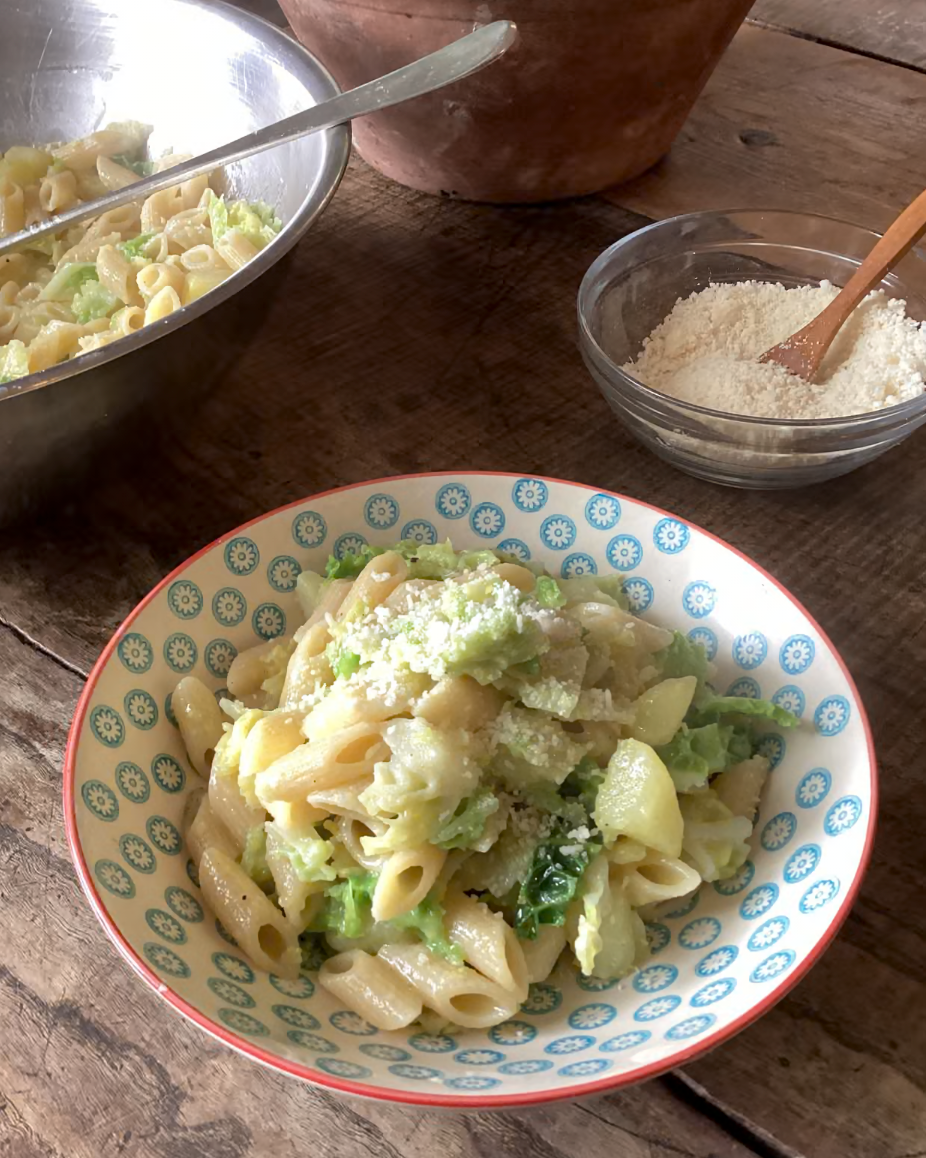
This is a Rachel Roddy recipe and how truly comforting it looks and sounds.
"It is also an inspiring dish for its method; the potato softens at the edges as it cooks with the pasta, the cabbage (which goes in later) softens enough to wrap and cling, while the melted butter, cheese and starch from the pasta cooperate and act like a starchy-but-slippy adhesive that brings everything together."
She suggests adding more cheese to your own dish and some chilli flakes too if you like chilli. I do.

The main ingredient here, would you believe, is stale sour dough bread. The recipe is from Tom Hunt - The Guardian's waste not man. You soften the bread in milk, then mix it with an assortment of fruit and nuts - soaked in some kind of alcohol, sugar, and egg, pour it into your tin - and voilà - chocolate cake. The photo makes it look as if it's a tart in pastry, but I think it's just the baking paper tightly folded to the edge of the tin. So next time you've really got a lot of stale bread give this a try. He suggests a particular nut and fruit combination but also tells you that anything goes really.

This is a very recent recipe ( March 2026) from a small coffee shop - the Little Joy Coffee Shop, 45 minutes south of Minneapolis, which has apparently gone viral around the world:
"Posting both a home recipe and step-by-step instructions for coffee shops, they asked shops if they wanted to be added to a map of places that will serve the raspberry danish latte. Hundreds of shops quickly signed up. A map of the shops shows a presence on every continent except Antarctica, with pins in dozens of countries. The map has nearly 2m views."
So what exactly is it? Well it is of course based on a Raspberry Danish pastry - which is a top seller in our local artisan bakery/patisserie:
"house-made raspberry syrup sitting at the bottom, followed by milk and a double shot of espresso. A vanilla cream cheese foam floats at the top, completed with two raspberries on a skewer."
Nobody is more suprised at its success than the owner of the shop - Cody Larson, who does say:
"There are sometimes detractors, like people who say the raspberry danish latte isn’t that original and didn’t deserve the hype.
To me, that’s the equivalent of the person in the Museum of Modern Art or something, looking at the abstract painting like, I could have done that. Well, you didn’t,”
Which I thought was a neat way of putting it. I don't know where you can find it in Australia - look up the map.
And finally two recipes from the latest Coles Magazine - both by Sarah Hobbs in a section on using spices in cooking, with brief descriptions of individual spices and what they can be used for. I rather liked the idea of these two - which look exotic and, indeed are exotic in terms of what I grew up with, but which in many ways are almost commonplace today.

The trick here is to use cinnamon swirl buns as the pastry - you use slices for the base and quarter slices for the edge. Designed to publicise Coles' own cinnamon swirls of course, but really you could use any kind of similar pastry. A raspberry Danish with raspberries? Probably not - but a plum Danish would work.

The chicken pie has quite a long list of spices in the filling, together with cranberry juice - it's kind of an Ottolenghi sort of dish. And that highly decorative top is easy to do. Butter your filo, fold it into strips and swirl it over the top before baking in the oven. It's quite a long list of ingredients, but dead simple, because you just mix most of them together. The liquid comes from the chicken itself, some lemon juice, onions, chicken stock and that cranberry juice. Even if you take nothing else from this recipe than how to make that topping, you will probably have tried something new.
YEARS GONE BY
April 21
2021 - Missing
2020 - Missing
2019 - Nothing
2018 - Nothing


Not sure about prickly pears, but the word drops must lead to Drops of God or Wine!! 😍