à la barigoule
"One cannot fix one's eyes on the commonest natural production without finding food for a rambling fancy." Jane Austen

This is my 'natural production' the Saffron milk cap mushroom - botanically known as Lactarius deliciosus - or the red pine mushroom. But in this case although it is the beginning of the food story here, it is not really the beginning of my ramble today.
For this has indeed been a ramble - but it didn't begin with Lactarius deliciosus - no matter how delicious it might be - and opinion is divided on that.
It's a ramble that has taken me to Herculaneum, Elizabeth David and co. to the heights of haute cuisine and Alain Ducasse, and the humble Coles Magazine - albeit one of Michelin starred Curtis Stone's recipes and my beginning point - his recipe for Crisp rump steak with barigoule carrots It did look pretty nice, but that wasn't really the recipe itself which inspired - it was really the word barigoule which triggered a dim memory of some Elizabeth David recipe I once made long, long ago - with a feeling that it was delicious, but a bit tricky.
So I set out to research the matter, and quickly found that the classic barigoule dish is one of artichokes - and I will definitely come to it, but although I worked my way through the artichoke story I just knew that this wasn't what I had cooked. I don't do artichokes - much too difficult to prepare, and for me anyway, not worth the effort. Although - and this is a thought I have just had - I am determined to find out what one can do with those jarred pickled artichokes.
What I was really looking for however was what it actually was that I had cooked all those years ago. I began to doubt myself and thought perhaps I was confusing barigoule with sainte ménéhoulde because I definitely remembered olive oil - lots of it.
I found a couple of recipes that used other vegetables - for example Anna Jones' Late-summer barigoule and White asparagus à la barigoule - Emily Chia/Natoora, but these were variations on the classic artichoke theme, not my olive oil remembrance.

And then I found it - Nicholas Clee The Sceptical Cook had had a go at making Elizabeth David's Potatoes barigoule with the same frustration that I had as well, and which was well described by Lorenzo M. who commented on the post:
"I followed the recipe as exactly as possible with Yukon Gold potatoes using an alarming amount of olive oil & cooking at medium high for most of the 25 minutes, turning the potatoes once after 15 minutes. The liquid was not all absorbed as she suggested (about a half cup remaining) & the potatoes had stuck quite badly to the bottom. So that was all rather distressing. The potatoes came out a beautiful crackling golden color & tasted superb & I will try again using a thicker bottomed pan & less olive oil."
Nicholas Clee used less olive oil than Elizabeth suggested but had the same sticking problems, and no golden colour. They don't look that great do they? And I can tell you mine looked much the same. In her book French Provincial Cooking Elizabeth tells us it is "a typically southern method of cooking potatoes". With which I would agree, but barigoule? Isn't it really fondantes?
Nevertheless when you look at her actual recipe for Artichokes à la barigoule (as described on Rosa Lawrence's website - the second picture below) you will see that she uses the same method as for the potatoes - lots of olive oil - and water in this case - which Rosa Lawrence describes thus:
"She described it as a primitive barigoule, involving only a startling amount of olive oil, water and artichokes. The water-and-oil emulsion spits and sputters as the water evaporates leaving only oil, but it's all part of the fun (as is cleaning up afterwards)."

This is Richard Olney's version in Provence the Beautiful Cookbook, which I now see as a kind of transition between the olive oil approach to the majority understanding today of a braised dish. In his version he first sautés a mirepoix - finely chopped carrots, celery and onion with some Provençal herbs - artichokes on top and then a little olive oil and wine cooked until it is all almost absorbed and evaporated.
And that's one kind of evolution.

And here is another - a transitional recipe that I found on the Elle website - well the picture of it. The recipe was in French so I have not included it here. But as you can see it involves both artichokes and potatoes.
But what about that mushroom?
Well the French term for that mushroom is barigoule.
And herewith a sort of history of it all from the lady who writes Cooking is Much More than Recipes - together with her version of Artichokes barigoule. I know it's long, but she really sums it all up well:
"Barigoule is in fact the name given locally in Provence to a mushroom, the lactarius deliciosus, aka red pine mushroom. Those mushrooms used to be cooked in a certain way, simmered in a liquid, broth and/or wine with some other vegetables. I don't know which ones, but it is very likely that most of those were the same as those found in the current recipe as well as in many other Provençale stew recipes. Given that the mushroom is picked up in Fall while the baby artichokes used for the recipe are harvested twice a year, in Spring and in Summer, and that the mushroom and the trimmed artichoke have a similar shape, one can easily understand why the latter eventually replaced the former, seasonally first, then permanently. Another version, which doesn’t exclude the first one, is that the term was employed to describe a recipe of artichokes stuffed with barigoule mushrooms, and by extension with any mushrooms, before the recipe abandoned the mushrooms and refers now to an artichoke-only recipe."

A slightly different history is told us by Daniel Gritzer of Serious Eats, introducing his version of Artichauts à la barigoule which is probably a basic but classic version:
"Exactly why the dish was named after barigoule mushrooms is unknown, but it wasn't because it originally included them. Instead, it's likely it was because the artichokes were cooked in a style similar to the way barigoules were prepared at the time: trimmed like a mushroom cap, brushed with oil, then grilled. Eventually, Provençal cooks, inspired by the name, decided to make a mushroom stuffing for the artichokes, and the mushroom version—the one many sources cite as the original—was born. That lasted for a while, making its way into books like Larousse and Escoffier and convincing Madame E. Saint-Ange, the author of La Bonne Cuisine, that it had always been that way. And then, just as quickly the barigoules went away, an inadvertent twist that returned us to the dish's mushroom-free roots."
Well controversy as always reigns, but it does seem that mushrooms are not generally involved these days, and the artichokes are indeed braised in a light broth of wine and vegetables such as carrots - maybe Curtis Stone knew we wouldn't be able to deal with artichokes.
And our Cooking is Much More than Recipes author sums it all up thus:
"I refer here to an old traditional recipe where the original ingredient that gave its name to the recipe disappeared and had been totally substituted by a totally different ingredient. A case of culinary brood parasitism then!"
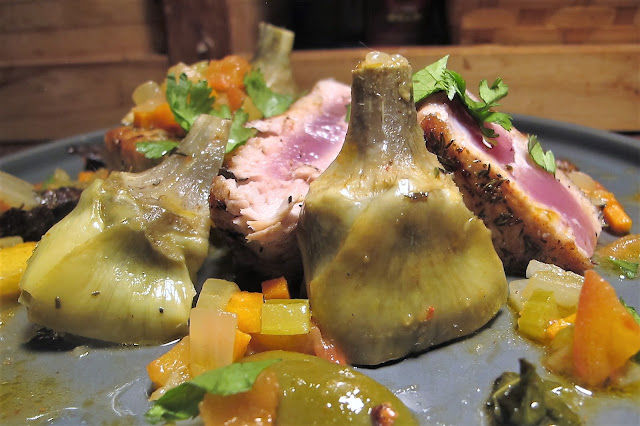
When I began I mentioned Alain Ducasse - because, of course there are haute cuisine versions - Vegetables à la barigoule with vanilla found on the Bon Appétit website is his. Then there is Robert Carrier, whose recipe is not online but shows the stuffed kind of version, although no mushrooms are involved, and perhaps the prettiest of all Artichoke barigoule from the Fallow restaurant in London:

I'll end as I began - with the mushroom - as shown on a fresco found at Herculaneum. Now I wonder how the Romans cooked them? Not with artichokes by the look of the fresco but very probably with olive oil.
I will say, however that I don't think I shall be cooking Artichokes barigoule any time soon. I'm not into artichokes as I said before. But I might have another go at those potatoes some time.
YEARS GONE BY
August 17
2025 - Nothing
2024 - Nothing
2023 - Nothing
2022 - Which fish
2021 - Missing
2020 - Missing
2019 - My pasta machine
2016 - The sex of tomatoes


Well you had my interest with a mention of Herclaneum in your 3rd paragraph and I read on anticipoation, but it was not to be. Ah well ...barigoule! 😅