Linzer torte - Italian, Austrian, Jewish?
"I didn’t have great hopes for this Linzer torte – it just seemed too simple to be really delicious." Alix Clark/SBS

And I have to say when I turned to my lucky dip page - this is a lucky dip recipe - I felt a bit the same.
When I think about it I don't think I have ever tasted a genuine Linzer torte. Did my mother ever make such a thing I wonder because I do remember something with a lattice top and maybe jam in the middle? If I did I doubt that my mother, or maybe even my grandmother knew that she was making a Linzer torte - or a version of it. To them it would have just been a jam tart, with the lattice on top to make it look pretty. Or am I confusing it with Bakewell tart?
Whether I have tasted it or not, and now having 'researched' it a bit I might even take Alix Clark's word for it, when at the end of her article she said "The big surprise with this torte was how good it tasted."

I will come back to her version - and various others, but let me go back to the beginning and this book - Central European Cooking. It comes from my highest shelf and is hardly ever looked at these days. But David picked it out and so here it is. It's from an American series called Round the World Cooking LIbrary and was published way back in1973 - 52 years ago. I probably bought it because it was an area of the world not covered much by any other of my cookbooks. The authors too are unknown to me - Eva Bakos and Albert Kofranek. And I can't find anything about them, other than seeing other books they have written. And what is Central Europe as defined by this book? Switzerland, Austria, Czechoslovakia, Hungary and Rumania - it says. Truly central in fact, although it ignores Southern Germany. The borders have changed of course since then - Czechoslavakia is now The Czech Republic, and Slovakia, Rumania is now spelt with an 'o' and maybe Ukraine should be included - it was the USSR back then. All of which has nothing to do with food of course. The people will still be eating the same traditional foods - along with the global foods that we now all eat.
Did I use this book much? Well yes I do think I made things like goulash from it and I do remember making a conscious decision to not throw it out, when I did a major weed of my cookbook collection when my kitchen was renovated, but at the same time I did relegate it to the top shelf. I should peruse it again. Maybe make Linzer torte for my next lunch or family gathering.
Why LInzer? Well you might think it is named after the town of LInz in Austria - Hitler's favourite town apparently - and maybe it is but there is another story, summarised by Wikipedia:
"The invention of the Linzertorte is subject of numerous legends, claiming either a Viennese confectioner named Linzer (as given by Alfred Polgar) or the Franconian pastry chef Johann Konrad Vogel (1796–1883), who started mass production of the cake in Linz around 1823."
But then again consider these other statements:

"it's the oldest cake ever to be named after a place" - The problem with this is that the oldest recipe that has been found for this cake comes from Verona - in the 1653 papers of Countess Anna Margarita Sagramosa of Verona - found in the library of the Admot Abbey - I just had to include a picture of this amzing library. Several websites mention this, but none of them say whether the recipe had the title Linzer torte or whether it was just a recipe for the same thing - a nut based shortbread pastry, a jammy filling and a lattice across the top. So I'm guessing that it is indeed the oldest written recipe for the cake, but not necessarily with that name.
"The Viennese confectioner named Linzer" - i.e - it comes from Vienna, not LInz. Well the second oldest recipe - 1696 - is from Vienna, although it's not clear whether that recipe is connected by the 'confectioner named LInzer'. Or indeed whether it also bears the name Linzer torte. People just cite apparently separate sources for the two. Nevertheless it's certainly true that it is indeed a very famous Viennese dessert.
Then there are the Jews, who claim it as their own - although I suspect this is more a case of them adopting the cake as part of their Passover tradition. I found a recipe for Linzer torte and cookies - on a website called Jewish Viennese Food - which stated that:
"the tribe can’t even live without it when forbidden to eat leavened food during the eight days of Passover."
It was a somewhat curious site, with to my eyes, switching from Jewish fervour, to cynicism. I suspect the fervour was uppermost because of this rather extraordinary paragraph:
"In the meantime, if you’re not Jewish, you’re probably protesting because outside the Jewish universe, in Austria, Hungary, Switzerland, in parts of Northern Italy, as well as in Germany, these are Christmas treats par excellence. Thus, there is a holiday where even anti-Semites celebrate the birth of a Jewish baby with a Linzer torte. The torte, in turn, depending on where you stand, is either a cake named after a town most beloved by the dead Führer (יש”ו), or a Jewish and Viennese treat. Linzer torte is simply a delicacy that is living, wildly mutating, and proliferating in the pastry shops of the world."
And the tart that the website photographed, had a star of David pattern on top which the author admitted was pretty difficult to accomplish. Those cookies are a common offshoot as well. The Jews of Vienna certainly seem to have adopted it as their own and when they emigrated to America in the nineteenth century they took it with them and from there spread it around the world - well so this site claims. Possibly true, but then again I'm pretty sure that the tourists who visit Vienna would have played their part as well.

So really the truth about origins is that nobody knows, but that people have been making it since the 17th century at least, possibly before as the Italian crostata which has elements in common date further back to the Renaissance. It's sad though is it not when people get seriously upset about origins? Take for example this rather glorious looking LInzer torte from a Facebook page called German Feast - in the comments section underneath the recipe there were several that said 'Austrian not German' sometimes with the Austrian written in capital letters. The author hadn't even claimed it as German - it's just the name of the site. And I bet it's made everywhere in Germany too.
I mean it's interesting to know the stories even if some of them turn out to be just that - stories. But with most dishes, except for those truly invented by a particular chef - it's always a chef, not an ordinary cook - people have probably been making similar things since time immemorial. They just didn't get written down, mostly because the people who made them couldn't write or, indeed wondered why you should. Tradition is mostly passed down in an oral way. Until it becomes codified by religions and other 'official' organisations. Or else money is made by turning a supposed origin place into a tourist trap - think Mère Poulard's omelette on Mont St. Michel, or the bellini in St. Mark's Square. Although on the plus side sometimes they build a fun festival around it.
But - yes as soon as they found how to make jam, and also pastry that was made from ground up nuts, somebody - well many somebodies - started to make things that looked like LInzer torte. It is after all pretty simple and therefore:
"since the jam or preserve is one of the cake’s main ingredients, the higher the quality, the better the taste of the final result!" Nino Shaye Weiss
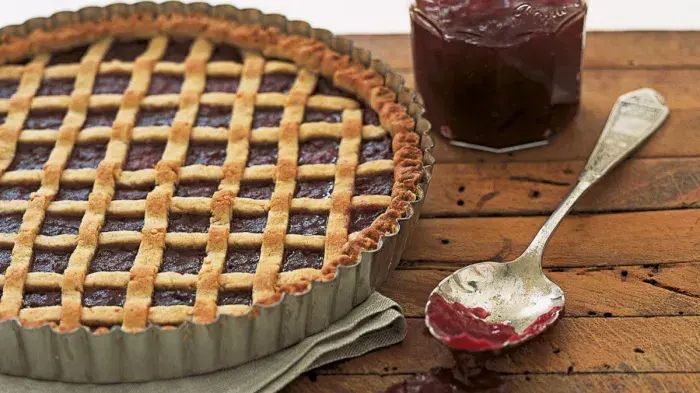
But what kind of jam? Well it's no surprise that there is no agreement on that either Delia Smith, whose recipe for Linzer torte is shown here says:
"The fruity element is usually either redcurrant or raspberry, but a while ago I tried using cranberry jelly instead and liked the result very much."
But then I did see somewhere that that original 1653 recipe used blackcurrant jam. One thing for sure however, is that, not only should it be good jam, but one thing is for sure, as Nino Shaye Weiss says: "the more the preserve, the better".

When presenting her recipe, another author, Meike Peters, when presenting her Linzer torte said:
"To me, Linzer Torte is not particularly wintery, it's made of two layers of buttery short pastry sandwiched with raspberry jam. It feels a bit like a dense fruit pie, maybe not as juicy as the layer of jam is quite thin and not a proper filling. It gives the pastry's flavours more space and makes it a bit softer. That's why the cake is best when it sits for a few days, a week is even better. The jam soaks the crumbly base and spreads its fruity aroma."
Mind you others, seem to slather on the jam quite thickly. And at the other extreme there's hardly any jam at all. Somebody even used lemon curd.

And what about that pastry? It's a short pastry but always includes ground nuts. And of course there are arguments about that too - hazelnuts seem to be common, but then again so do almonds, and also walnuts. Wikipedia also said that the top was not only decorated with a lattice, but had a border of flaked or chopped nuts as well. None of my examples showed this, but a few did mention it as an option. And I think there was even one version somewhere with no lattice and just nuts.
There's even one version which uses tahini in the pastry in stead of nuts - from Sarah Hampel of Bon Appétit who makes Tahini Linzer torte bars which she claims yielded a "rich buttery crust". She also pointed out that her pastry topping is fake in that the strips are just laid over each other rather than being woven as they are traditionally - and I now notice that Delia, for one does the same. Now the taste would be the same wouldn't it, so would it truly matter whether you wove the lattice or just laid the strips on top of each other? delicious. also departs a little with the pastry by using spelt flour - the recipe for Spelt and hazelnut Linzer torte tartlets is from Boonderoo Farm
So two final examples - the first from Deb Perelman on her Smitten Kitchen website - who is a big fan of Linzer torte - well she is Jewish - and American. Here is a good place to start because she has lots of very useful photographs of the process. Her recipe is adapted from a book by Maida Heatter. In her usual somewhat over the top way she says:
"Consider this a warning:I don’t think anyone only makes these once!" and describes it as: "delicate and spiced, firm but fragile, not overly sweet and absolutely stunning."
The other Linzer torte is from Alix Clark on the SBS website - lots of jam.
I shall now return the book to its high shelf, but will try not to forget that it's there.
THE FRIDGE - another leftover bit the dust last night - reheated tomato oatmeal tart.
YEARS GONE BY
January 20
2025 - To plan or not to plan
2024 - Nothing
2023 - A 46 year-old bottle of wine
2021 - Missing
2020 - Hail the size of golfballs
2019 - Nothing
2018 - Nothing
2017 - Heirloom tomatoes


Linzer Totre has an inyeresting history, especially for a pretty simple jam tart! 🫠