What am I to do with David Chang?

Today is the day I finish with this book which has been sitting on my desktop for a long time now, with lots of yellow stickers pointing out of it. Only two remain, and so it's decision time after a last post. Do I keep it, pass it on to my daughter-in-law who may find a use for it or put it in the street library?
I think I'll eliminate that last option. It's too good for that. Because really my indecision comes down to just two things.
First - I confess I am not hugely into the kind of food that he cooks. This is partly because I don't know enough about it, which is one reason I should keep this book. Because it does indeed educate you into the Japanese/Korean/Chinese kind of Asian food if you know what I mean. They are not my favourite cuisines, but then every now and then I discover a really great recipe. And if I do want to be educated into the ingredients and the techniques - which include microwaving - then this is the book for you perhaps.
Secondly - It's focus is indeed on teaching - there are huge bits of information about just about everything you would need to know about Momofuku style cooking - cooking generally as well. How to wing it really. "How I learned to stop worrying about recipes" as the subtitle of the book declares. I have written about this book a couple of times before - the somewhat irritating design, the pages of 'know-how' ... so today I think I will just present a few recipes and perhaps some further thoughts on what I'm going to do with it.

I'll begin wih what is really the first recipe - on page 93 - which tells you how much 'teaching' kind of information you have worked your way through before you get to this. I suppose it's technically not the first recipe - the first is a whole chapter on how to cook meat - the various meats, with a Q&A with a food scientist - and then you get three pages on how to shop for brisket. All valuable stuff but for me I guess this is the offputting part of the book - I either know it all or don't really want to know all the more technical and scientific stuff about deckle and the other various parts of brisket. Which is lazy and probably stupid of me if I really want to be a superb cook. Nor do I really want to know the science of what is happening to the meat as it cooks.

But then on page 93 we have the first actual recipe, answering the question 'So I have my cooked brisket. Now what?' To which he replies 'Make my adaptation on a quick beef noodle soup.' He tells us it's a riff on Kau Kee Beef Noodle Soup from Hong Kong - the Kau Kee bit being the name of a Michelin restaurant. I've looked that up and I have to say that David Chang's look more appetising. But that might be the same old brown food doesn't look good thing. It's pretty simple - the broth you got from cooking the brisket is heightened with more flavour from garlic, lemon juice, red onion, a jalapeño, some agave syrup (a favourite ingredient of his) and pepper. Cook some noodles, and when cooked put in bowls with slices of brisket which have been seasoned with soy or fish sauce; pour over the broth and top with sliced spring onions, and/or toasted sesame seeds and pickled vegetables.

It's not my kind of dish really. I prefer my soups from Britain and Europe I guess - with a few exceptions. However, on the next page there is a variation of the above - some Ice slushy noodles (Mui naeng myun) with a large black circle containing these words about the differences between restaurant and home cooking which are interesting:
"To give you an idea of what I mean by restaurant cooking versus home cooking, in a restaurant I would have properly skimmed the broth so there was no fat on the surface. I would have trimmed the fat on the brisket better. I would have properly julienned the carrots, radishes and scallions. I would have dipped the scallions in iced water so they'd look curly. I would have plated the noodles so they are going in a single direction. And I wouldn't be serving my noodles in a mixing bowl."

Recipe number two - Cook corn in ... corn. This rather intrigued me although I'm not sure I would like it. Too much corn? Indeed his co-author Priya Krishna said of it:
"This is very good, but I would say that while I thought it was good on its own, it felt almost more like a flavor base or a condiment than a stand-alone thing - it's pretty rich, like eating pimento cheese with a spoon (nothing wrong with that). But when paired with pasta as a sauce, or used as a base for a soup, it feels more balanced. Try it in tacos with radishes, avocado, black beans and diced onions."
What he has done here is to blend some frozen corn cobs with milk and then cook fresh corn kernels (or tinned ones) in it - together with any seasoning you fancy - he suggests mayo and cotija; miso or chaat masala - and then you can add whatever you like from prawns ot just herbs. Eat as is, serve it as a side or over rice. Maybe the soup thing - but yes I think it might be a bit rich.

Recipe number three - which I'm also not sure about. It's a very different way of making cacio e pepe which I'm pretty sure most cooks, chefs, foodies would deplore. He says he contrived this method because of the washing up:
"The cheese almost always gets stuck to the pot, and it is a pain in the ass to clean."
Just use a non-stick pan say I.
Anyway - what he does while the pasta is cooking is:
"Microwave a few glugs of olive oil and a spoonful of peppercorns for 1 minute. In a blender, combine the olive oil, peppercorns, a pinch of MSG (really?), at least 1/2 cup of the pasta water, and hunks of parmesan (no need to grate) and pecorino (ditto) - probably about 4 to 6 ounces of cheese total for a whole pound of pasta. Blend until homogeneous and saucy. Add the sauce to the pasta and toss vigorously. If it is looking too dry, add a little more pasta water."
So what about washing up the blender, and you still have to wash up the bowl you've tossed it all in?
Having now learnt how to make cacio e pepe easily with Rachel Roddy, I don't see the point of this one. I put it in though as it shows the kind of devil may care attitude I think - and the lateral thinking as well, of which we should all have more.
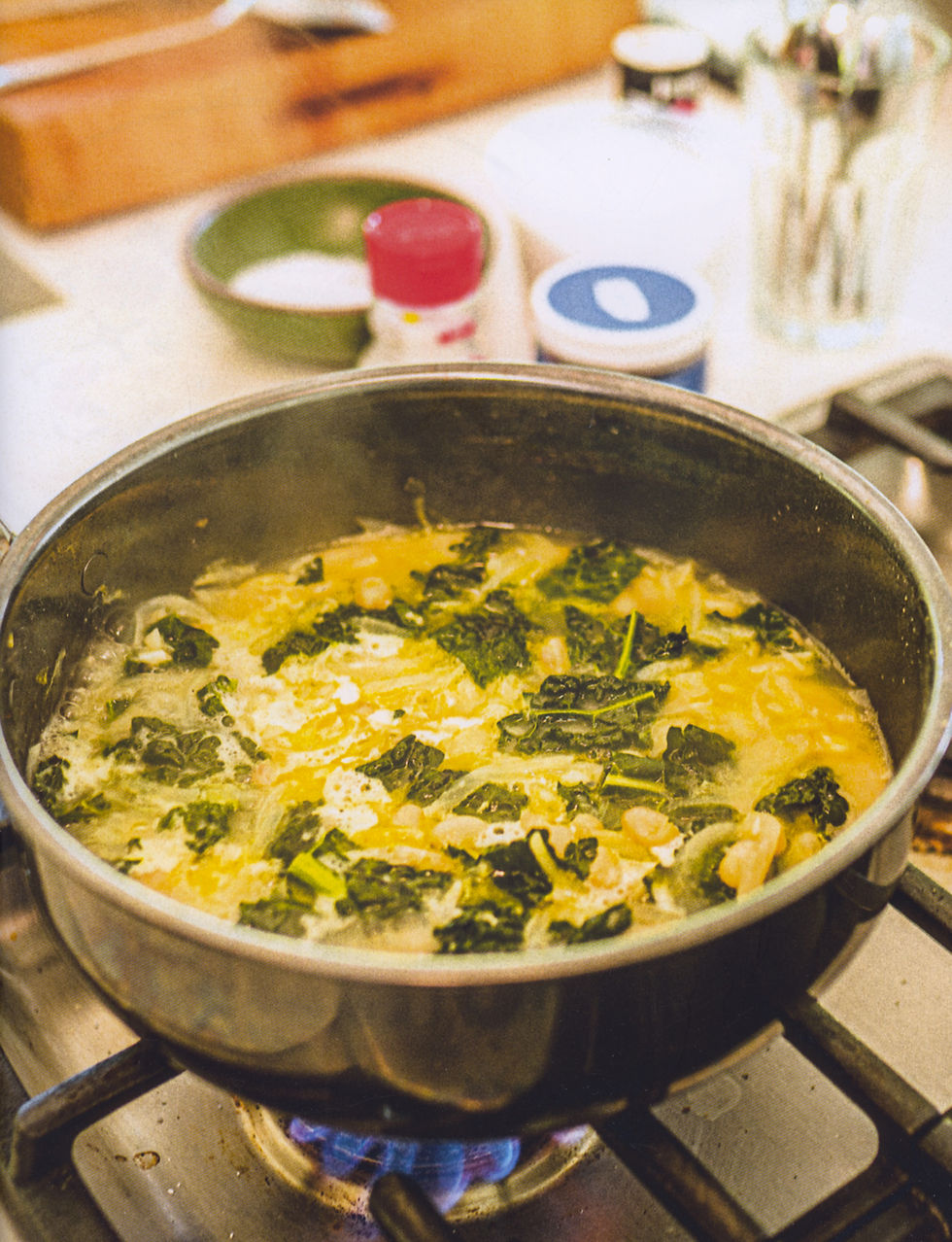
Last recipe - Choose-your-own adventure beans - partly based on the idea of a Tuscan kale and bean soup I suppose. But as he says: "every time I make them, I take the beans to a different country" and you can too.
Soak the beans overnight and then next day fry beans and garlic to soften, add a ham hock if you want, the beans and water. 'Add the seasoning of your choice' and cook the beans until soft - keeping an eye on them and the level of water. When almost cooked add shredded kale - or whatever greens you fancy and garnish with whatever seems right. You can purée or not.
A good example of an infinitely variable dish.
It's an interesting book in the contrast between the heavy scientific and technical stuff - almost too much information and lots of it very dry - there's an essay from a NASA scientist for heaven's sake - all of which is seemingly completely at odds with an almost slapdash approach to cooking. Shortcuts, flexible ingredients and quantities - a cook it until it's done kind of philosophy. Which is why I'm tempted to keep it. And yet - am I actually going to use any of the recipes? I sort of know the recipes like the beans and kale. I'm not attracted to things like Asian soups and Chinese pork. So yes maybe I'll pass it on to my daughter-in-law.
Good, different ...
YEARS GONE BY
May 16
2025 - Nothing
2024 - Tablecloths
2023 - Tacos - where to begin?
2022 - An English last meal - goodness what a coincidence - we had roast beef for dinner last night!
2021 - Missing
2020 - Missing
2019 - Is it in the genes?
2018 - Slow
2017 - Nothing


Comments