Provençal garlic soup
"[one of the] most delicious meals ... eaten by the poorest people in the world." Jamie Oliver

And then turned into food for the rich:
"Soups made with chick-pea water or chestnut water, or even garlic and sage water, are found in country kitchens today, or are translated into glamorous clear consommés complete with saffron or rose petals in the leading hotels of the region." Robert Carrier
This is my lucky dip of the moment. Garlic soup in Robert Carrier's wonderful ode to Provence - both rich and poor - Feasts of Provence - and this is the glamourised version he is talking about.
And here I'm resigning for a bit, in favour of Robert Carrier, and his introduction to La Soupe à l'ail.
Because (a) he knows all the background, and (b) because he says it all so much better than I.
"One of the great peasant soups of Provence is 'aïgo -boulido' (boiled water), which, at its simplest, is really a healing broth made of boiled garlic cloves and fresh sage leaves served with a sprinkling of freshly grated cheese. Famous as a restorative because of its garlic herbal properties, this simple soup is one of the great classics of the Provençal repertoire. It used to be the first food given to infants when they were weaned, and a double-edged traditional saying celebrated its qualities" "L'aïgo boulido, sauve la vido; au bout dóu tèms, tuo li gènt. (boiled water saves lives, but in the end it kills people)." 'Aïgo-boulido' has many guises: chopped Swiss chard and sorrel are sometimes added; a hint of saffron or dried thyme is often recommended; and the steaming-hot bouillon may be poured over slices of day-old or oven-toasted bread - drizzled with a few drops of olive oil and rubbed with a cut clove of garlic - to give more substance and body to the soup. And on gala days one egg for each guest is poached in the bouillon."
So now we have something quite presentable: the soup is made of finely chopped greens, whole garlic cloves and fresh sage leaves; seasoned with saffron, salt, ground pepper and red pepper flakes, and served over a slice of oven-baked, garlic-rubbed 'pain de campagne' on which one lightly poached egg is placed.
All this is still a far cry, however from the amber-tinted 'consommé à l'ail, à la sauge et à l'œuf poché served by PIerre and Jany Gleize at La Bonne Etape in Haute Provence. Here the saffron-flavoured beef bouillon - holding its surprise cargo of strips of tender beef, gently poached egg, curling strands of saffron and thin slivers of red rose petals - is anything but rustic in character."
It's a great example of how the simplest of peasant foods evolves over time and strata of society into something you can serve in the most beautiful setting, on the most expensive plates in a MIchelin starred restaurant in Haute Provence.

I'm tempted to say - "what more can I say"? And truly - not a lot - other than that is one of my favourite Robert Carrier books. Published in 1992 and much more glamorous in presentation than his earlier books, this covers all the Provençal favourites, and at the end of each section presents a menu from one of Provence's most famous restaurants. But humbler cooks and restaurants are also given their due with special homage to the mentor of his youth - Fifine of St. Tropez.
We also get Carrier's mini essays about a particular dish, or a place or person, or personal experience.

So here's an aside on that restaurant that he mentions - La Bonne Etape up in the hills behind the coast of the French Riviera.
Because this book was written way back in 1992 I thought that the people he spoke of -Pierre and Jany Greize might well be dead. I also thought it was a man and his wife. But no it was a man - Pierre - now in his 90s - well he may be dead now - and his son Jany. The two men are shown here with Jany's daughter Jane who now runs the restaurant with her father. She will be the fifth generation of the family to own the hotel and its Michelin starred restaurant, which reopened around 2020 after COVID disruption. A rich tradition. It must be in the genes, which is interesting in itself.
But back to that soup. I found one website that had this origin story:
"It is said the broth was first invented by hikers venturing the trails of Provence. They would pick up herbs along their way – sage, bay leaves, etc. – and boil them in spring water to eliminate any germs." Pardon Your French
Which reinforces the health idea and also, unlike many origin stories, sounds as if this is quite possibly how the soup came into being. And having just watched Jamie and Julia's Jamie make Julia Child's garlic soup (Aïgo bouido) (shown below) it seems that even Millenials think it's healthy (and delicious).

And picking up herbs along the way would explain why several recipes that I have seen actually put in a mix of herbs rather than just sage, although sage does seem to be a bit of a constant.
Elizabeth David seems to be a bit less of a fan because her opening words introducing her recipe are "This is a soup only for those who like their garlic unadulterated.", although perhaps she should have said those who like their garlic in vast quantities. I have now seen recipes that vary in number between The Grieze's (in Robert Carrier's recipe) 12 fat cloves - I think somebody else only had four which seems a bit tame for a soup that owes it's name to garlic - to 4 whole heads. (Simon Hopkinson) I even saw one comment on the Jamie and Julia video that said:
"Made garlic soup once. Misread the recipe and went with 33 bulbs of garlic. Thankfully I noticed after I had roasted them, result was I had plenty of roasted garlic mash in the freezer, and a garlic soup."

Re that note about roasting the garlic, this is one of the things that modern day cooks like to do. We love roasting garlic don't we, and there is certainly no doubt that it has a wonderful taste, but the name of the soup - boiled water - says it all really. You're meant to boil the garlic. However, here's an example from Food and Style - whose writer is from one France's South Pacific territories - I don't know which. Her Aïgo bouido (Provençal garlic soup) as well as roasting the garlic also contains potatoes and uses a bouquet garni rather than the traditional sage.
Another common variation is the addition of eggs - as in Julia Child's recipe, in which , having cooked your broth and strained it, you beat 3 egg yolks, and then do the adding of a little bit of the hot soup whilst whisking strenuosly technique, before returning to the rest of the soup. Sometimes people just stir the beaten egg into the hot soup, so that they get eggy strands, sometimes a poached egg is added to each plate. Even a raw egg yolk.
Then there's the adding bread bit. Slice the bread and toast it, or use stale bread, then either put it in the dish before pouring over the soup or float on top with some grated cheese on top.
Provence is not, of course the only place to make a garlic soup. Virtually all of Mediterranean Europe has a version, all with their own unique touch. Garlic grows wild in Europe, and water is always available, as are herbs whether grown in your own vegetable plot or foraged from the wild. Simon Hopkinson has an English version - Ullwater wild garlic and potato soup for example, which also has leeks and cream - but no herbs - and no picture.
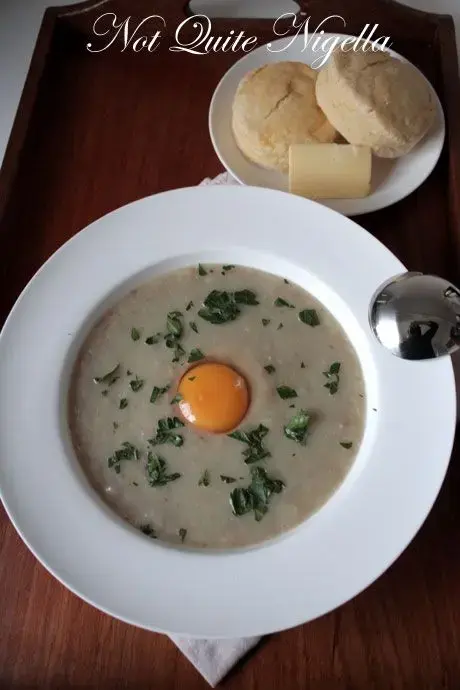
But I'll end with another Michelin starred chef's version - Alain Ducasse's cream of garlic soup as made by Lorraine Elliott on her Not Quite Nigella website. The egg yolk is raw, there is bacon in the mix and potatoes too which provide the 'cream' part of the equation. There is no actual cream. Lorraine Elliott made it to cure the flu, and she said she felt a lot better having eaten it - although she did admit to taking medicine as well. Who knows.
I might try it some time, but there is such a range in how much garlic to use - 4 cloves to 4 bulbs. Maybe one bulb.
YEARS GONE BY
March 17
2025 - Leftover pizza
2024 - Pierogi from Poland
2022 - A mixed bag
2021 - Missing
2020 - Missing
2017 - In between summer and autumn


Comments