Pasta, flying saucers and grannies
"a personal undertaking to try every single type of pasta available the length and breadth of Italy" Jacqui De Bono

Time for a look at a foodie blog and the next one on my list is The Pasta Project, which is probably one of the first that I recognised and visited from time to time, so I'm not sure why it took me so long to get to it with my website posts. I probably came across it long ago because - well it's pasta isn't it and I guess we are all pretty much obsessed with pasta. As Jacqui De Bono - the writer of the blog says there are:
"around 360 types of pasta (shapes & sizes), others claim 400 or more. And of course, if you multiply that by the number of different accompanying sauce recipes (each type of pasta is traditionally or typically served with a particular sauce or sauces, depending on its shape and the region it comes from), I guess that would make pasta one of the most varied foods in the world."
Elsewhere she said that so far she has only covered 100 or so, so far. That's in 10 years, because, like me she began writing her blog in 2016 and is still going - at the rate of about one post a week. Will she make it? that's another 36 years at the same rate. So probably not.
Jacqui, pictured below is originally from London, although she spent some time in Malta. I don't know when or for long. One assumes it was more than a brief holiday since she mentions it somewhere. In 2003 she went to Italy where she met her husband Salvatore who is originally from Sicily I think, but they now live in Verona. No children are mentioned, and neither does she say what she worked at before she began her blog in September 2016 - so I have a two month start on her. There is really no mention of why she decided to write a blog about The pasta which she loved and which intrigued her. And I could find no interviews.
But here she is - a modest success I assume, as there are plenty of ads on the website, which has the same standard layout - and colours too of so many other foodie websites. Well probably lots of other kinds of websites too. I have no idea whose template it is - Wordpress? And it does indeed have all those increasingly common ads popping up here and there and interrupting the text. So a black mark for that. Although I guess that's how she makes her money. She has published at least one book too and if you subscribe to the site you get free ebooks as well.
I'm guessing the ebooks are about particular regions that she occasionally focuses on. I decided to focus on her three most recent posts and fortunately one of these was Pasta recipes from Tuscany - entirely relevant of course, having written about two Tuscan cookbooks yesterday.
She begins with a rundown of the different kinds of pasta which include dichi volanti - on the left - and pici - a long and thickish kind of hollow spaghetti.
But the dichi volanti led me into a bit of a ramble around the net - as well as her own website. Which is actually what her website does well. As well as links to other related recipes, and information, each pasta has its own page - with the story of how it came to be, how it is used and so on. The page for dischi volanti had a wonderful story attached.
Dischi volanti means flying saucers. The pasta is a relatively recent invention as somebody needed to invent a bronze die to make the shape - which does indeed look a little like a flying saucer - Garofalo make the same shape but they call it cappelletti - which means a small hat - not nearly as wonderful as the story that goes with dischi volanti, which she briefly tells, although referring us to the BBC and an archived article The Day UFOs stopped play. The story goes like this.

In October 1954 in the middle of a football game in Florence hundreds of disc shaped objects appeared in the sky over the stadium. The crowd and the players were mesmerised and one of the players, Ardico Magnini, later told the press that:
"It was something that looked like an egg that was moving slowly, slowly, slowly. Everyone was looking up and also there was some glitter coming down from the sky, silver glitter."
It was so dramatic and received such a huge amount of press coverage that in 1955 the bronze die for the dischi volanti was designed.
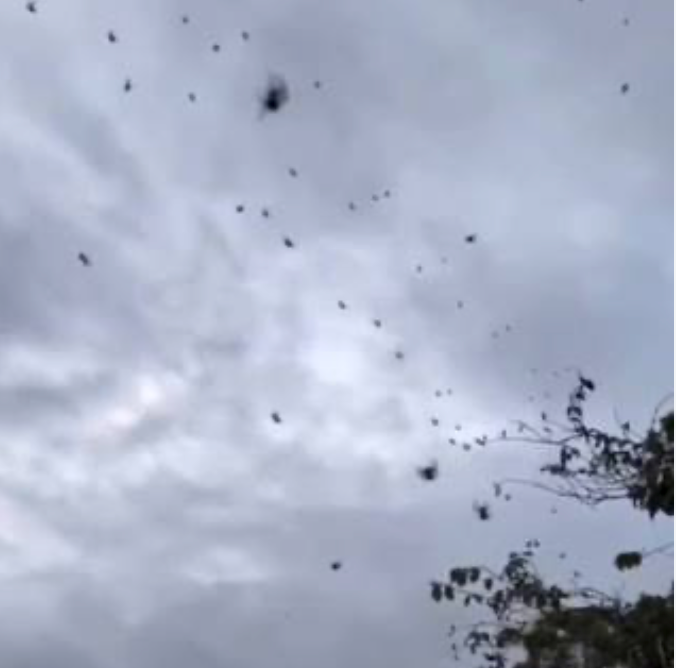
However it seems that it wasn't flying saucers. Well there is no surprise in that. It was probably a migration of spiders. The spiders release some silk that catches the wind and carries them along in the air. The silk drifts to the ground and covers it. It's known as an Angel Hair Event - and there's a short little video which shows it very clearly. The event shown in the video is from Brazil but it's apparently particularly well-known here in Australia. Wonderful stuff don't you think and you can see why the crowd and the players stopped to watch - apparently there can be thousands, even millions of spiders in an event like this. The things you learn when you're reading a foodie blog!

And you get a recipe too - maybe more, but in this case I think, that so far there is just one - Prosciutto ragu with dischi volanti
The recipe page includes some information about how prosciutto is made, and as with all of her recipes there are photographs of the process of making the recipe - which in this case includes telling you that you need chunks of prosciutto to dice, rather than slices. I'm guessing your supermarket deli would give you thick slices if asked.

Her other Tuscan pasta - pici is given its own page and a recipe Pici all'aglione which is a simple dish made with tomatoes and a very special kind of garlic called elephant garlic. Which I'm guessing we wouldn't be able to find here - but she suggests using leeks and garlic together instead. Or just garlic, even onion. And again there is an extra - a paragraph or two about elephant garlic, what it is and where it comes from. Plus - about pici - also very old and from the Etruscans It is sometimes called pici senesi which means from Siena -and it has a host of other names:
"‘pinci’ ‘lombrichelli viterbesi’, ‘pisciarelli’, ‘torcolacci’, ‘filarelli’, ‘lilleri laziali’ ‘ceriole’, ‘stringoli’ and ‘raguzzi’, depending on which region or town you are in!"

Back to her page on Tuscan pasta. After telling us about shapes she continues with recipes, beginning with three soups - all including some kind of legume, which seems pretty authentic to me having, over time, realised that Tuscany has a very large number of bean recipes. The first of the soups is Tuscan chickpea and pasta soup her version of Striscia coi ceci - a classic soup which she has made her own way, but I have to say it looks pretty good.
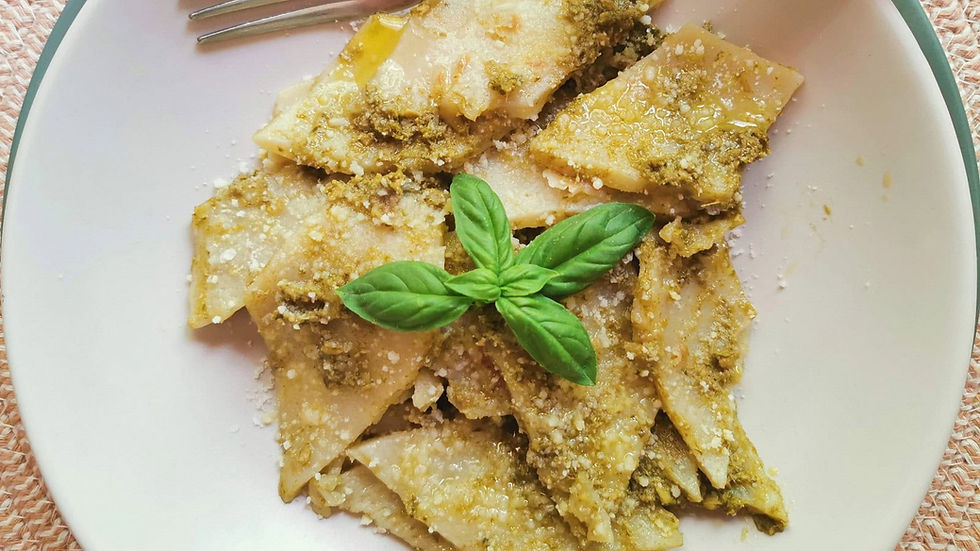
Then she gets to the most interesting pasta - well sort of pasta - in this section - Tuscan Testaroli pancake pasta. She tells us that it is said to be the oldest pasta in Italy - dating back to Etruscan times, from the region of Lunigania an area which contains the border regions of Tuscany and Liguria. In some ways it's not really a pasta, being made from a thick batter which is made into a kind of pancake.

She referred her readers to a rather wonderful shortish video - some 7 minutes - from the Pasta Grannies series, in which a 96 year-old nonna demonstrates - with the help of her grandson how to make Testaroli at home - as long as you have a round cast-iron hinged plate with a long handle that is. There is also a demonstration from a restaurant I think where the equipment was even more specialised and it was cooked over a charcoal fire. But back to our granny - who made a series of these pancakes, each one spread with some pesto, piled on top of each other and then cut into wedges like a cake.
That's one way of serving them. The other way is to cut your pancakes into pieces - diamonds, squares - whatever, then cook them like pasta before serving them with a sauce - most commonly a pesto based one, sometimes with nuts. And I guess it's this second method that has led to them being classed as pasta - and it's the method that Jacqui De Bono uses.
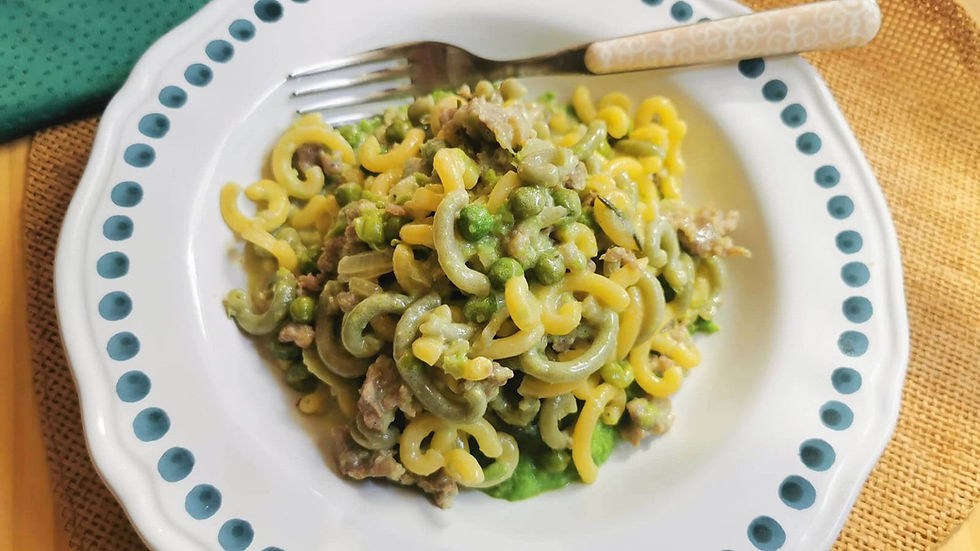
Back on the home page we find her most recent post - last week - is Gramigna pasta with Italian sausage, peas and cream - which we learn comes from Emiglia Romana. Before making this dish she had never used sausages in her pasta cooking but it has led her to other sausage pasta dishes for which she gives a list.
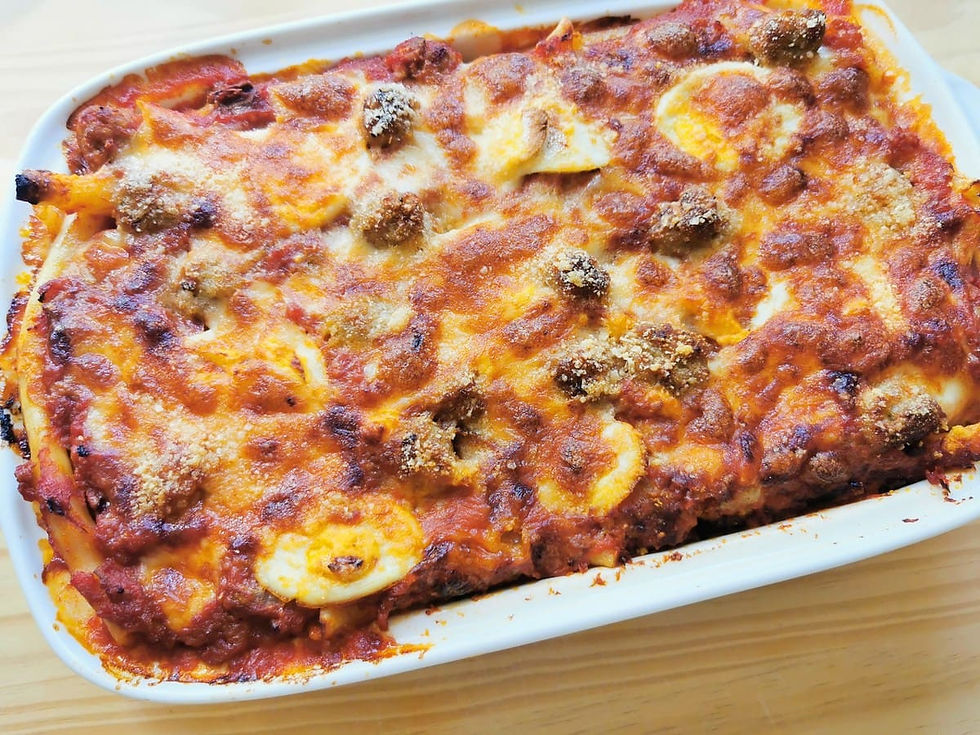
The third recent post is for Baked ziti alla Lucana - which is from Basilicata, although ziti itself comes from Naples. But this dish is from Basilicata and so we get a little bit about Basilicata before the recipe which is: "loaded with ingredients including a tomato and porcini sauce, scamorza cheese, tiny meatballs and hard boiled eggs."
The name Lucana is from the Roman colony of Lucania and ancient Lucani people
I spent a pleasant time hopping from one thing to another because of her links to this and that, either on the recipe pages or the information ones about places and pastas. And now that I know that it's there, if I need to know anything about pasta I have a look. There's not always an answer - well she's only covered a hundred or so of Italian's vast range of pasta shapes so far, so that's not surprising.
Who knew about floating spiders though? And who knew they sort of invented dichi volanti or cappelletti in memory of the event. You can find cappelleti here and indeed I bought some, or was gifted some once. They're a great shape to use. Thank you spiders.
YEARS GONE BY
October 3
2025 - And again
2024 - A little drop of poison
2022 - Morello cherries
2021 - Missing
2020 - Missing
2018 - Beauty = joy
2017 - Shakshuka or Chakchouka


Comments