Menemen, Ottolenghi and cultural appropriation
- 1 day ago
- 5 min read
"something hot with eggs on it" Itamar Srulovich
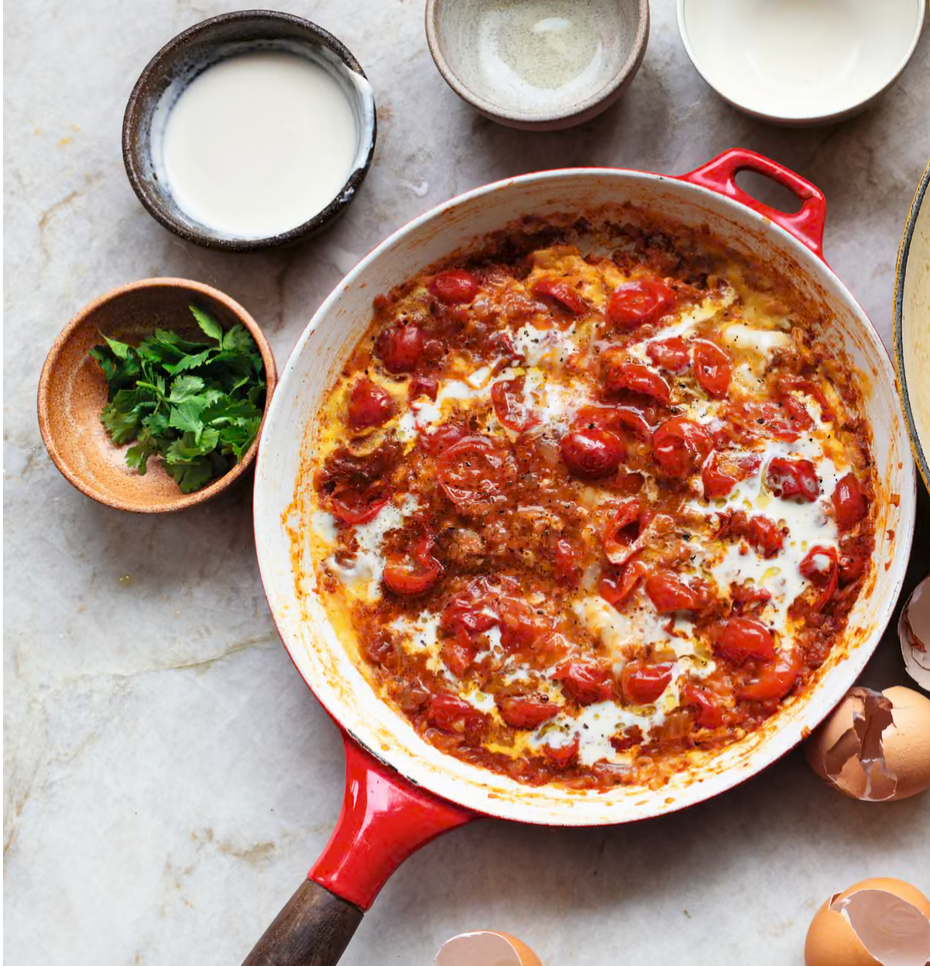
For Ottolenghi fans the 3rd of this month was a big day - the publication of his next book - this time with long-time colleague in the OTK (Ottolenghi Test Kitchen) Verena Lochmuller - Simple Too. For me the big day was yesterday when the book arrived here. I realise that this is not necessarily a big thing for any of you, but for me it certainly is.
And this is the first recipe in the first section Breakfast/Brunch - Menemen so this post is going to be mostly about Menemen with a few words - about the book.
It looks glorious and even though I know I shan't be making it anytime soon because David doesn't like eggs, I decided that it being the first recipe it was a way into the book itself - and a prime example of Ottolenghi - or anyone else for that matter messing with a traditional dish.
It's a very old dish:
"There is a thirteenth-century Arab recipe from Baghdad for something called ‘onion scramble’ (in Charles Perry’s translation). It consists of onions fried in sesame oil combined with eggs. The eggs are beaten with spices and stirred together with the onions ‘until it is pleasing’." Bee Wilson
The tomatoes of course came later, and today are absolutely crucial - indeed I would say that the tomatoes and the scrambled eggs are the only constants. And as food historian Noam Siena says - as quoted by Bee Wilson in her long essay on Shakshuka - " shakshuka should be defined less by its ingredients than its technique". And yes they are talking about shakshuka but the same principle can certainly be applied to Menemen.

I have now seen several recipes for Menemen, with all manner of additions to the basic tomatoes and eggs.
The two almost constants are onions - although there are real arguments about this - and green peppers. Green peppers seem to be less controversial, although there are arguments about what kind of green pepper. Ottolenghi doesn't include them - really his dish is just tomatoes, onions and eggs - plus various flavourings of course. Which I shall get to.
In addition to those some people even added sausage of various kinds, or minced meat - which, for me, anyway, is a step too far to be called the same thing. As to flavourings - chillies of the Aleppo or Urfa kind, paprika, garlic, oregano, sometimes thyme, whilst Ottolenghi goes for cumin, cinnamon and coriander leaves.
Yoghurt appeared a few times and Ottolenghi preferred double cream, but it's not a usual addition. Cheese on the other hand is more common - feta - and various Turkish cheeses.

But as Noam Siena said it's the technique that matters and the technique is to soften your vegetables (not the tomatoes), add your flavourings and the tomatoes - Ottolenghi adds some tomato paste as well - cook until it's all the right texture - a Goldilocks position of not too wet and not too dry - and finally add your very lightly beaten eggs - just to break the yolks really - over the top, stirring gently until just about set. Eat with bread. But not with spooky looking black gloves.
If you are adding cheese you add it with the eggs.
I do like scrambled eggs, and this does indeed look delicious, so maybe when the family is all gathered together in New Zealand at Christmas we could have it as a special breakfast. Or I could make a small portion for lunch one day. Just for me.

The name, by the way, is not a Turkish word - it's a place - I think the one shown here. An unpreposessing place I have to say - and the reason that this place has given the dish its name:
"after Cretan Muslims resettled there during the 1923 population exchange between Greece and Turkey These settlers are said to have initially prepared simple dishes of wild greens with eggs and olive oil, later adapting a local tomato-based stew by substituting eggs for meat during a period of economic hardship, with green peppers added afterward to give the dish its present form. The dish reportedly spread beyond the region after the 1930s." Wikipedia
Which seems a bit vague to me. I'm pretty sure that if there was a 13th century reference to such a dish it must have evolved over the centuries surely. Anyway one thing is sure - the dish is always called Menemen. And indeed Lorraine Elliott of Not Quite Nigella tells us that:
"Some say that the dish was first made by shepherds in the Aegean region of Turkey who had easy access to eggs, tomatoes, onions and capsicum peppers."
So when Ottolenghi - and others tinker with the formula are they being culturally insensitive and inappropriate, or are they merely adapting to their own tastes a genre of cooking eggs and tomatoes together that is found all around the Mediterranean? Is it alright for Ottolenghi to finish his dish off with double cream and coriander, and to spice it with cumin and cinnamon?

Is it alright for J. Kenji López-Alt of Serious Eats - who goes a bit overboard with the olive oil - to use Padrón or shishito peppers and add some chives in his Menemen? He is a bit apologetic about the chives:
"It's not traditional, but I added a small sprinkle of chives to the dish, because eggs and chives were made for each other."

And Lorraine Elliott of Not Quite Nigella is equally apologetic about the amount of cheese in her Menemen:
"My extravagant use of cheese at the end is all my doing. I had a big ball of mozz that needed using up and in it went where it was glorious. I have no regrets."
Not traditional at all but if you like lots of mozzarella - really not a Turkish cheese - then maybe this is for you. It was also just what she did on that particular day, because she had that leftover mozzarella. Who knows what she did on other days. On this day she also added some sausage - a Turkish variety called Sujuk.

Perhaps the most traditional version of Menemen that I found was on The Mediterranean Dish - website but even she says:
"I was first introduced to this delicious dish while on a trip to Istanbul back in 2006, and have since been making variations of it."
And at the end of her piece she references the closeness of this recipe to the more well-known Shakshuka:
"I consider them close cousins. The two popular egg dishes are quite similar since they share some key ingredients (eggs, tomatoes, peppers, and onions), but the seasoning and preparations differ."
And then I found - rather creepily - this from Meta's AI on Facebook: Shakshuka vs Menemen - cooking differences

And just to underline the universality of technique over ingredients, in that same Guardian article where you will find Ottolenghi's Menemen recipe and also on the next page of his Simple Too - you will find this Coconut greens with scotch bonnet and eggs which comes from half a world away in Trinidad. Greens not tomatoes, and Trinidadian spices, but eggs cracked into it - just like shakshuka. Now has he culturally appropriated two different traditional recipes here, or is it just something interesting to make for breakfast or brunch one day?
Lots more to investigate in the book. Another time.
YEARS GONE BY
September 7
2025 - A supermarket label
2024 - Choices - Leftover soup
2023 - Capsicum (peppers) and pasta
2022 - Gleanings
2021 - Missing
2020 - Missing
2019 - Nothing
2018 - Comfort food - someone else's thoughts - a sort of 'a word from...' and (I wrote two posts on this day! - Chicken soup for a cold
2017 - The end of a long project
2016 - Oversize


Ottolenghi say no more /.//got the latest bok!! Woooeee! 👍