Spanakorizo - Greek comfort food
“a little rice for a mountain of spinach” Tessa Kiros

Having now investigated this Greek bit of home cooking, I have come to the realisation that when one explores a dish like this, and finds lots of variations of course, one ends up by thinking that the very first one that inspired you to write the post is of course the correct way to do it. Never mind everybody else doing it differently to a greater or lesser degree - the first is the truly authentic one.
In this case it is a man called Nick Bramham who wrote a short piece on the Vittles substack newsletter on this dish. If I was a paying customer I could also get the exact recipe. But do I need one? He more or less gives it on his Instagram post and also on the Vittles newsletter which also gives you the background, as it were:
"Spanakorizo, which literally translates as ‘spinach rice’, is a traditional Greek dish that you are unlikely to find in Greek restaurants, even in Greece (believe me, I’ve tried). It’s typically made at home – an everyday chuck-it-all-in-a-pot-and-forget-about-it kind of a dish, the gold standard of minimum-effort, maximum-reward cooking. Spring onions and garlic are softened in olive oil, then joined by rice, spinach and water and left to simmer gently while you potter about doing something else for an hour. You’ll return to a silky homogeneous risotto-esque mass, which you then spike with copious amounts of dill, lemon and black pepper."

It's particularly curious in the context of this post because he is not Greek, nor a specialist in Greek food. He is British - actually English I think and is head chef at a posh wine bar called Quality Wines in London's Farringdon district - which from memory is near the centre. Just looked it up on Google maps - indeed - plum in the middle of the incredibly trendy - nowadays - district of Clerkenwell.
But then he's a chef and has probably holidayed in Greece, so why not? Maybe he has some Greek friends, maybe he just likes Greek food. A quick look at the Quality Wines website suggests the food he cooks is fundamentally European with lots of Italian and French - but yes the Spanokorizo is on the lunch menu.

And whilst we are on the topic of foreigners cooking Greek Food and this particular dish being a home dish, not a restaurant dish, Jill Dupleix reckons that there is not a Greek cookbook without a recipe for it. And she mentions a few - one of whic is by Tessa Kiros. I have this book Now and Then which JIll quotes, and yes indeed there it is, but no photograph and no recipe online.
To further illustrate that this is really one of those almost anything goes, almost non recipes - this is Jill Dupleix's version - and to give her credit she doesn't give it the 'official' Greek name but calls it Dill and spinach rice with feta admitting that she plays around with it to suit herself - e.g.
"Most traditional recipes will start with onion, sometimes leeks or spring onions. They use spinach, sometimes silver beet leaves as well. They always cook the greens with the rice, often par-cooking the spinach beforehand for up to 30 minutes. Sorry, can’t do that. I wilt the spinach, add the herbs and fold that through towards the end of the rice cooking time, which still gives it that signature slippery butteriness."
And she finishes her article in typically breezy Jill Dupleix fashion by saying:
"I’ve made this with proper leafy spinach (what we call English spinach in Australia), and with a couple of bags of baby spinach, and the proper spinach is better. I’ve used red, white and brown onion (red colours the rice) and I swap to leeks in winter. I’ve used basmati, jasmine, arborio and SunRice medium-grain, and they all work.
Everything works. Even if you burn the onion a bit, it works. That’s why it’s a keeper."

But then there are the traditionalists, the ones who cook their yiayia's recipe like this Greek spinach and rice - Spanakorizo from Olive Tomato whose author tells us
"There is absolutely no garlic in this traditional recipe. I see it often on other sites, but the authentic Greek recipe does not contain garlic."
Which is indeed true in some cases, but in others not.

Another example is Yiayia's authentic spanakorizo (one-pot Greek spinach rice) from Marina Karris/Taste who says:
"you can’t skip these crucial things. Firstly, add salt to the onions while they’re cooking so they can release all their sweetness. Then, be generous with the salt and olive oil. Make sure to taste the liquid before you place the lid to let it simmer and add more salt to taste."
And she adds tomato paste - or maybe its passata - but a tomato boost anyway - which some do and some don't. Indeed one recipe just said it was optional.

And what about those herbs - most usually dill - a lot says Jill Dupleix, but The Mediterranean Dish lady whose Spanakorizo (Greek spinach rice) is shown here, uses dried ones - dried mint - well yes that's another ingredient all of its own - but dried dill? Now she is one of the top bloggers on Mediterranean food, so you would think she would be right - but to my mind there doesn't look to be a lot of spinach in there, and surely spinach is the whole point?

So then I tried to think of actual Greek authorities that I knew of. George Calombaris? He might be somewhat disgraced but he is of Greek origin and a respected chef - foodwise that is. So yes he does have a recipe - but it's more of a risotto, and this is a version of his recipe made by a blogger called Arcis who half gives the recipe and also comments on what works and what doesn't. It also doesn't really sound very like the traditional tropes - parsley not dill, and really so much more like a risotto. So a real Greek who is being very untraditional.
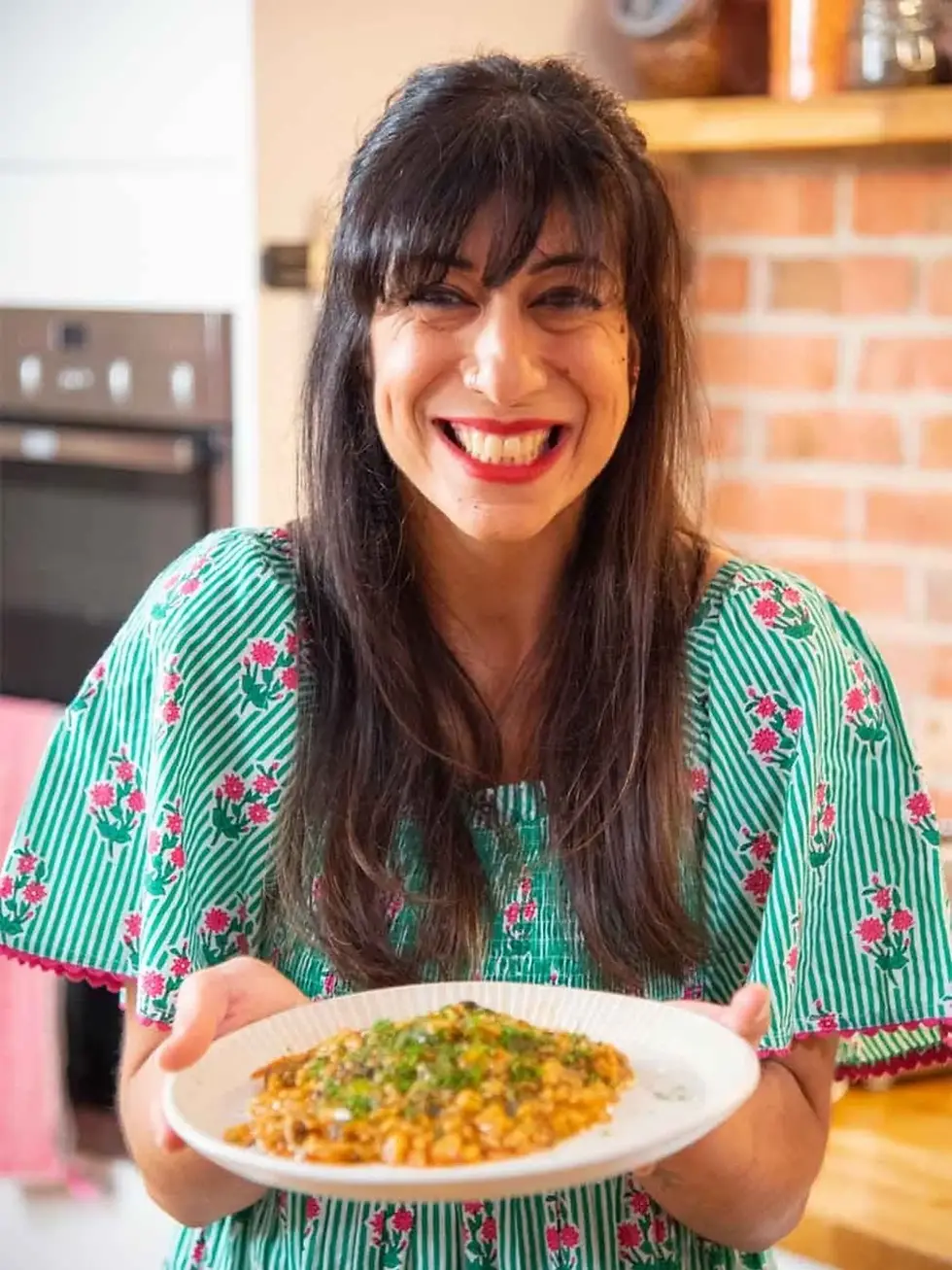
Then there is England's Georgina Hayden, who is of Greek origin. and has written several Greek cookbooks. Her recipe for Spanakorizo is from her book Nistisima and appears on the Jamie Oliver website. Also not a very traditional take as there is smoked paprika in there - and that forbidden garlic.
So I guess the conclusion is that Greek bloggers, do indeed tend to be pretty traditional, and they are the most likely to get uptight about whether you are doing it right according to their grandmother's recipe. Whether that's a question of garlic, tomatoes, cheese or no cheese depends on whose grandmother you are listening to.
Those with some of the most 'researched' and careful recipes tend to be from other nationalities - like these last two examples - Spanakorizo - Phoebe Wood/delicious. and Spanakorizo with jammy eggs - Hetty Liu McKinnon/The New York Times - the eggs are not traditional but that depends on whether you regard this dish as complete in itself or as a side dish to something else, or something to be topped or mixed with other things - like prawns or shredded chicken as Jill Dupleix is prone to do.
Comfort food for the Greeks, something to play around with - respectfully - and to refine it into something really special - for everyone else. And yes you can use frozen spinach. But don't tell your Greek grandma.
YEARS GONE BY
April 23
2025 - The seasonal divide
2024 - Nothing
2023 - Nothing
2022 - Scary carbonara
2021 - Missing
2020 - Missing
2019 - The King Valley
2018 - Green


Talking of traditional Greek food, what did the original ancient Greeks serve up for dinner. Spanakorizo? 🤣