Fruit fools
"Savlon for the tongue" Nigel Slater

That's a somewhat weird, maybe even repulsive or at least unattractive way of describing, what to me and many other English people is the most sublime of desserts - particularly the gooseberry version.
‘Soft, pale, creamy, untroubled, the English fruit fool is the most frail and insubstantial of English summer dishes’
says Elizabeth David and even Claudia Roden - doyenne of Middle-Eastern food describes them as "one of the delights of summer"
But then NIgel was writing that when he was suffering from a hip injury when gardening, so feeling sorry for himself. And besides when you think about Savlon it is indeed soothing - bland and healing, so why wouldn't a fruit fool, like boiled rice, be soothing too? A bit too clever by half? Maybe but potentially an intriguing hook. Well that's what I hoped for anyway.

However, it wasn't Nigel who started me on this it was Claudia Roden and her book Picnic that brought this subject up for me today. It's a lucky dip - David picked the book, I picked the page, and almost immediately rejected it, because I know very well that at some point in the past I have tackled fools. But then I rebuked myself for starting the year with avoidance of rules I had set in place myself, and decided that the passing of time, or simply the fact that I am writing this at a completely different time, means that a new angle or so may subsequently appear. And anyway many of you will either not have read the original, or won't remember it anyway. And I just found it, so if you want to check it out - it was a part of a discussion on strawberries and rhubarb - then just click on the link.
Picnic is actually my favourite Claudia Roden book as it's full of the quick and easy but different things that you might fancy for a picnic but also for a home-cooked meal. Plus there are lots of interesting facts and stories, reminiscences and information about the whole concept of the picnic. An old Penguin that is falling apart, and has no glossy pictures, just some evocative line drawings scattered throughout.

But I'm rambling. Back to fools - beginning with Claudia's - and my - favourite - Gooseberry fool - specifically Jane Grigson's Gooseberry fool which has been made by somebody at The Guardian in the opening picture for this post. The recipe that Claudia provides in PIcnic is Jane Grigson's. This one here is Delia Smith's Gooseberry yoghurt fool a departure from the classic by using yoghurt - which several others do today. Delia 'excuses' this by saying:
"I now find that lusciously thick genuine Greek yoghurt makes the best fruit fool of all, as it allows the full flavour of the fruit to dominate. If you're serving this to someone who doesn't like yoghurt, don't worry - they won't know."
Not that any of us here in Australia are going to be making gooseberry fool any time - we used to be able to get them for a week or so in a year - and I would buy some for said gooseberry fool no matter what the cost - but I haven't seen them for years now.
One thinks of the French and the Italians getting all hot under the collar when anyone tampers with their national and regional classics, but the English get very argumentative when it comes to fools. All the articles I have read for this post, for example, quote this from Simon Hopkinson:
"The fool is one of the few quintessentially English desserts that should not be tampered with. I have know it to be made with cream and custard but I don't think this is necessary. The perfect fool, for me, is just cream, fruit and sugar."
Interestingly it seems that when fools first were made - way, way back in the Middle Ages, they would actually add all manner of things to the basic fruit and cream - lots of spices, and things to decorate them, but gradually they realised that the very simplest way was the best:
"If you whip cold double cream slowly and softly in a chilled bowl, then fold in a handful of strawberries you have crushed with a fork, you get a simple but pure fruit fool. Cool and soft, it is the most soothing dessert you could think of ... Sometimes fools can be almost as simple as stirring fruit into cream" Nigel Slater

Or as Felicity Cloake puts it for one of her perfect fools of which The perfect damson fool is an example
"There are essentially four main steps to this popular dessert: chop fruit, cook fruit, whip cream and combine (unless you count devour greedily)"
Felicity didn't mention sugar in that instance, but indeed sugar - at least a little - is often essential for some of these tart fruits. 'Cook fruit' is only necessary when you are dealing with something like her damsons - another thing you can't get here - although my wild plums are close. The choice of damsons is a favourite with the Brits - as indeed are all fruits that are slightly tart - raspberries, gooseberries, rhubarb, strawberries. They don't seem to like plums or peaches or apricots because the slightly tart fruit is soothed by the cream, and the sweet fruit is dulled by the cream.
Some of those cooks do seem to think that a bit of custard in the mix is traditional (NIgel even sometimes uses shop bought custard), or whipped egg whites to lighten it and some barely crush the fruit, with some left whole:
"Other fools can delight by having a small amount of the fruit left whole amongst the softly whipped cream." Nigel Slater
Which he does with his 'accidentally concocted' Blackberry and apple fool/Hokey Stokey which comes from his book Tender Volume 2. Jamie Oliver too, with his Blackberry fool. Both of which are fundamentally true to the idea of cream and fruit, but not quite a fool.
Why not a fool? Well fundamentally the generally accepted historical derivation of the name is from the Old French - 'fouler' which means to crush or to mash. However there is another idea, as Jane Grigson discovered:
"I used to think that the word fool came from the French fouler, to crush. Seemed logical, as to make a good gooseberry fool the berries should be crushed rather than sieved. But I was wrong. It's a word that goes with trifle and whim-wham (trifle without the custard) -names of nonsensical bits of folly, jeux d’esprit, outside the serious range of the cookery repertoire"
Because, yes, it is indeed a joyful, almost childish thing:
"Fool. The very name is joyful – a childish whimsy of a pudding, all fruit and froth, which brings back memories of long days idling in the garden with an E Nesbit novel and the warm rubbery smell of a sun-bleached orange space-hopper. There's innocence in its glorious simplicity" Felicity Cloake"
Of course once you start adding in some of the whole fruit, you then maybe start adding other stuff as well because:
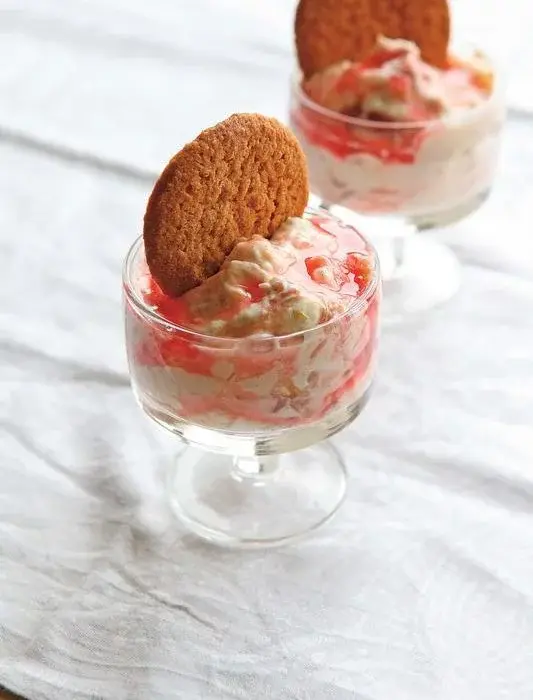
"Time after time, the most satisfying fruity puds follow this neat formula: sweet-tart fruit, starchy, crisp or crunchy carbohydrate and a luscious, creamy dollop on top (or underneath. Or even in the middle). It's a tremendously treaty trinity that seems to satisfy every sense, with each element pointing up the sheer loveliness of the others." Hugh Fearnley-Whittingstall
And so he gives us Rhubarb, ginger and cream - a touch of difference with the ginger, although it's an ancient combination - and a modern ginger nut biscuit for the crunch.
The 'starchy, crisp or crunchy carbohydrate' however, really is an extra that takes you away from fools and into other territory - the Scottish cranachan or posh Eton Mess for example. Of course there is nothing wrong with this, but the fool just becomes something different - even ice-cream if you freeze it, or mousse if you add egg yolks and lighten it with egg whites:
"Turn the fool into an Eton mess by folding in crumbled meringue along with the fruit, or mix things up with pieces of biscuit, mini marshmallows, granola, honeycomb, chocolate chunks, caramel sauce, pieces of birthday cake … the only limit is your imagination. To turn your fool into a showstopper, pile it up in a large dish, cover it in hundreds and thousands or edible glitter, and add some birthday candles." Felicity Cloake
And so I looked to see if the experimental Ottolenghi did anything amazing and found two recipes which, to be fair he did not call fools - but creams: Rhubarb fool(ish) with black tea ice-cream and Blackberry, yoghurt and orange blossom cream - yes it's a stretch and there are countless recipes from chefs everywhere, that fundamentally contain those elements nominated by Hugh Fearnley-Whittingstall - fruit, cream, and crunch. It's the degree to which you vary those elements isn't it?
The thing that really fascinates me about them however, is why is it such an English thing? Why, to take the most obvious examples of nations somewhat dedicated to cream, didn't the French and the Italians do the same thing? I couldn't really find an answer although AI had a go - telling me that they preferred to eat fruit just as it is, or else turn them into sophisticated pastries, mousses, soufflés and so on. Just fruit and cream? Simultaneously too fussy when plain perfect fruit is all you need, or just too simple and childish for words when simply added to cream?
Here in Australia they are not really a big thing either, although Messes seem to be coming to the fore. And this is probably because all of the fruits that star in the fool are mostly too hard to grow here - except for the blackberry which is a noxious weed and gets sprayed everywhere it grows wild. Yes we can now get raspberries, strawberries and rhubarb - the last because it's trendy? all year, but never any of the currants or the gooseberry, damson or greengage.
But here is Nigel to the rescue with two recipes which are so Australian somehow - Mango blueberry fool - yoghurt not cream, however, and some lemon juice too, because the mango is otherwise too sweet and Mango and passionfruit fool which has just a little yoghurt to balance the sweetness of the mango.
Apparently even in England the fool is not a favoured dish. Michelin starred chef Jeremy Lee when he was at Quo Vadis, would serve a fool, but said his customers would not choose it when they were also offered things like profiteroles. It's not fancy enough. But then you can make it yourself - go and buy a mango and some blueberries, beat up some cream and eat something almost as divine as Gooseberry fool which I consider to be the food of the gods:
"the kind of thing that women are said to favour, but that men eat more of," Jane Grigson

FRIDGE CLEARING UPDATE
Well I did find time to make some jam - in the microwave, from strawberries, rhubarb, grapes and blueberries. Just three small jars - and a half as well which is in the fridge waiting to be eaten. These are waiting for their labels.
We also ate the leftover Christmas vol-au-vents - they tasted alright, but pretty ordinary really. In my opinion anyway - not nearly as good as fresh - and the leftover meat sausage rolls - the vegetable ones are on the menu tonight. We also finished off the blueberry jelly and the lemon posset for dessert - with some leftover chocolate crunchy bits on the posset.
I might eat the last strawberries tonight - maybe I should just crush them into cream for a truly authentic fool. Yes!
Still a long way to go though.
YEARS GONE BY
January 3
2024 - Nothing
2023 - A glass of wine
2021 - Missing
2019 - Salads then and now
2018 - Nothing
2017 - Nothing


Gooseberry Fool or any other traditional fool suffers from it unhealthy impact on the Gut - especially the Microbiome which undelays our immune system. It us definitely not a Savlon for the Gut! A yougust based fool is a step right directuin as would a Kefir based Fool or any Fermented Form of Food. Remember the Three F's! 😜