Everything bagel
"a doughnut with rigor mortis (alias chewy and dense and just a bit hard)" Claudia Roden/Nami-Nami

I thought I was just going to be writing about a particular spice mix sold in Coles, but find, that I am indeed going to dip into 'everything bagel'.
I emphasise dip. There are many more learned articles out there from Wikipedia's bagel page to J. Kenji López-Alt of Serious Eats' The good bagel manifesto.
The picture here is of one website's - Tasting Table - pick of the best bagel in New York City in 2022 - current day home - with Montréal apparently - of the bagel. The verdict on this particular bagel (which I think is an everything bagel?) assuming that this is what one looks for in a bagel:
"It has a noticeably fluffy yet toothsome interior, hidden beneath a flavorful crust. This well-baked bagel skin provides just the right amount of chew. The dough has a yeasty and ever-so-subtle sweetness that manages to complement everything from a light swipe of salted butter to a full cream cheese, lox, tomato, and red onion sandwich." Allie Chanthorn Reinmann/Tasting Table

In his bagel manifesto J. Kenji López-Alt has this to say on the subject:
"If there is one Golden Rule for good bagels, it is this: A Good Bagel Shall Not Require Toasting. All Else Follows."
With this photograph of what a good bagel should look like.
Today we think of bagels as being Jewish American - well I'm pretty sure we do, but Wikipedia maintains that:
"An early mention of a boiled-then-baked ring-shaped bread can be found in a 13th-century Syrian cookbook."
It seems that later in history the bagel, more or less as it is today began in Germany and was taken to Poland by a German aristocrat who became the queen of Poland. I can't remember how at one point it became a Jewish thing, and particularly an Ashkenazi Jewish thing, but obviously it got to America with the flood of Jewish immigrants to America in the 19th century.
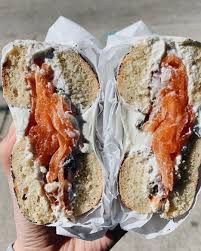
It seems to be most often eaten with 'lox and schmear', as shown here, which is cured salmon - a kind of gravlax - cream cheese with red onions, tomatoes and capers. It looks huge - and just as an aside I read somewhere that the size of bagels has grown over the years. Like everything American. I wonder when Americans became obsessed with 'big' in every way?
What makes bagels distinct from other bread rolls - apart from the hole in the middle is that the dough is boiled before being baked. This is what gives it the external crunchiness and blistering of the skin. Of course commerce has found ways around this from ignoring the whole boiling thing, to workarounds such as steaming, and various machines that somehow fake the process.
If you want to have a go at home however, Felicity Cloake will take you through the process of How to make perfect bagels whilst Stella Parks - an American writing on the Serious Eats website gives us her way of making Homemade bagels - using a slightly different technique - the Japanese yukone technique for which you:
"combine flour and water and cook them on the stovetop into a thick paste of gelatinized starch before incorporating that paste into a dough. That paste magically* helps breads retain their moisture and achieve a super tender crumb."
So what's the hoo ha about Everything bagels, which apparently have taken the bagel world by storm - well since back in the 70s or 80s - to demonstrate how far behind virtually all foodie trends I am? What's the difference? Well not a lot. Fundamentally an Everything bagel is just an ordinary bagel with a specific spice mix on top. So what is it and where did it come from?

Well if you read Everyone who invented the everything bagel by David Farley of the American Taste website you will find there are four different men who claim - sort of - to have invented the Everything bagel, although their origin stories are similar - working in a bakery and suggesting using the leftover sweepings in the ovens of the toppings for the finished bagels to top new ones. Whoever and whenever - the dates are between the 70s and late 80s - the Everything bagel is now the most popular bagel by far - or as David Farley says, it's become:
"a default way for chefs to sprinkle a bit of New York City sensibility across their cuisine."
And Christopher Pugliese - one of the supposed inventors of the phenomenon says:
"I think we have less subtle palates than we did in the 1980s, and the everything bagel really just pops with flavor—which is maybe one reason why it’s so popular."

Australia's own Sally of Sally's Baking Addiction will show you how to make Homemade everything bagels, and you would have to say they look pretty good.
So what's in the mix? Well there doesn't seem to be a lot of dispute, although I'm guessing the quantities will vary between recipes - but there are dehydrated garlic and onion, poppy seeds, sesame seeds and salt in there
Then Trader Joe's got in on the act and produced an Everything bagel mix for sale in supermarkets everywhere. Which interestingly, are banned in South Korea - and a few other countries as well because of the poppy seeds in the mix. Why? Because they class poppy seeds as a narcotic. Remember the poisonous poppy seed tea? Not here in Australia however. You can buy it in supermarkets here too - home brand versions as well as Trader Joe's.
J. Kenji López-Alt of Serious Eats insists on adding caraway seeds to his mix because 'they belong there' and doubtless others have their own take - well Ottolenghi for example goes much more exotic and adds Aleppo chillies and nigella seeds, and if you watch Adam Liaw on the SBS Facebook page make his and then make his Bacon and egg everything bagel roll, you will see him put a whole host of other things into the mix. And Coles has a recipe for Everything bagel seasoning too - which is a pretty standard mix.

Which brings me to the inspiration for this post - the recipe on the cover of Coles Magazine this month - Everything bagel chicken schnitzel - devised by their Food Director, Sarah Hobbs to publicise their own Everything bagel seasoning. I had actually seen this seasoning on their shelves, and wondered what it was and why it had that curious name, so when they blasted it all over their cover of this month's magazine I decided to investigate.
The recipe is pretty simple, though it does have nice touches like the srirarcha mayonnaise and the apple and celery salad to accompany it. Interestingly when I look up the product on their website it lists the ingredients as sesame seeds, onion powder, salt and garlic powder. No poppy seeds, although there are definitely some dark seeds in the mix. Maybe black sesame seeds. And maybe they too are steering clear of the poppy seeds. Although you can buy poppy seeds, so there is obviously not a ban. Woolworths do sell a mix but it's not their own.
There is nothing more about Everything bagel seasoning in the magazine which is also marginally interesting. You would think that with such a specific ingredient featured on the front page there would be more. But no. There are not even any tips for other uses - which are plentiful - just a brief paragraph from Sarah Hobbs on how to cook the chicken so that it doesn't burn.

Elsewhere on their website however you can find this recipe for Everything bagel biscotti where the seasoning is mixed into the dough - not just sprinkled on top, which is what it seems to be mostly used for. Although it can, of course, be used in any way that you might use any other spice mix.
But somehow so American. No - so New York. I sometimes think there is not just an American cuisine but there is also a New York cuisine with a massive Jewish component.
YEARS GONE BY
April 17
2025 - Nothing
2024 - Nothing
2022 - Nothing
2021 - Missing
2020 - Missing
2019 - Fridge cakes


Off to get Coles magazine
Not a fan of Bagels, and now having found out their Syrian origin, I can understand why! Syria is part of the Mad Middle East. Nothing good seems to come out of countties destroyed by Isam in the 7th century AD. 😱