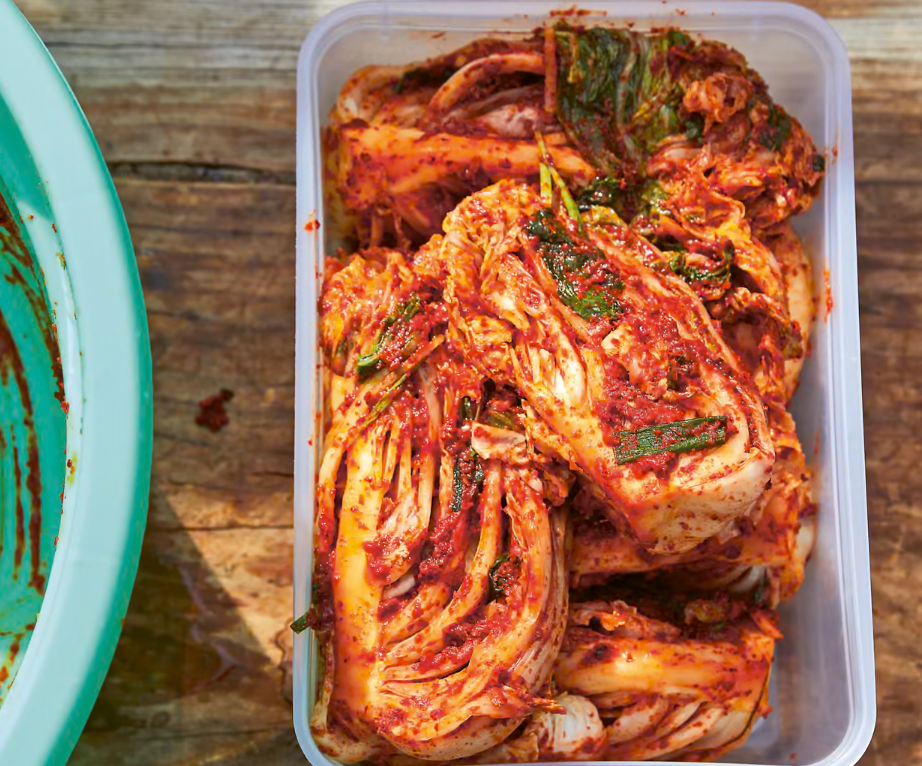
David Chang's fresh kimchi(s)
"Kimchi … you know you can just buy it, don’t you?"
Zoe Williams/The Guardian

And yes I do know that you can buy kimchi - indeed I bought some a little while ago to add to something I was making. It was in the recipe. I can't remember what the recipe was, and nor, to be honest can I remember tasting the kimchi. I do remember eating some in one of the dishes served to us at Ho-chi Mama in the city a long time ago - and that was delicious. It's one of those ingredients like sriarcha, miso, yuzu, gochujang, harissa ... that are so, so ubiquitous and trendy that I vowed to explore them by concentrating on one of them for a month. A beginning of the year resolution yet to be started on.
I'm also trying to reduce the pile of books on my desk requiring attention from a post point of view. The problem with that one is that no sooner is one taken away that another is added.
The connection is the book on my desk - David Chang and Priya Krishna's Cooking at Home tome. Just two more post it notes to explore after this one. Today the subject is a two-page piece called Make kimchi. Alas no picture of the finished product - unless that's what's in the jar behind the bowl on the left above. So I went looking online and found that Mr. Chang has a few recipes online for kimchi.
And of course there are lots of other recipes online as well - I will come to some of them - but having now explored a couple of pages from which one or two have been chosen I have given up - particularly when I found, for example that SBS food has well over a page of different recipes and articles on the topic.
And every recipe is slightly different - the Koreans say there are over 2000 variations in Korea - because - as one Australian Korean chef, Jindu KIm, tells us on the SBS website
“In Korean tradition, we never have a proper recipe. We actually call it, ‘the taste of the hands of mum’.”
Or put in even more philosophical terms by another Australian/Korean chef, in The Guardian:
"Kimchi is important like air is important. More than a foundation of our cuisine and a must with every meal, it’s an accompaniment to our lives, threaded into daily and yearly rhythms."
And her version - Cabbage kimchi (Baechu kimchi) - there is at least one glaring difference from the norm - if there is one - that I can see from the photograph in that the cabbage is just cut into wedges, rather than chunks.
It's just one of those things that every culture has in their home kitchens all made in a slightly different way to everybody else's - like tomato sauce in Italy, vinaigrette in France, BBQ sauce in America ...

Having now perused a number of recipes I can say that common ingredients - I'm tempted to say obligatory ingredients - are korean chilli powde-gochugaru; salted shrimp; soy sauce, lots of garlic; fish sauce; and - of course lots of salt. You don't even need cabbage however, as Tom Hunt demonstrates with his Brussels sprouts kimchi. Common alternatives are radishes - the Daikon kind I think, apples and carrots. Which must mean that it's the method and the flavourings that really count and that make every version more personal.

But what about the cabbage - the cabbage that makes it Baechu kimchi? Well I began with David Chang who calls it Napa cabbage - as do many others, and because he is American I thought the 'Napa' bit was somehow connected to the Napa valley - famous for its wines, but then thought I, maybe they were famous for cabbage too. But no - 'napa' comes from a colloquial Japanese word 'nappa' meaning any kind of vegetable leaf, especially when used for food. Which possibly is why the Napa Valley is called the Napa Valley. I must look into that sometime.
Anyway this is what we Australians call wombok or Chinese cabbage - readily available in your supermarket and a bargain too - well all cabbages are really, however expensive because they last a long time and can provide many meals. I imagine you can use other kind of cabbages too.
Before I get on to offering a few recipes and to David Chang in particular, a few words about the process - which in a way is summed up by those terse words at the top of the page - you can indeed buy it. You don't need to do this. Zoe Williams, went on to say in even stronger terms:
"The wisdom I have to impart here is that just because you like a thing, it doesn’t mean you have to perform it yourself. Just buy it in a shop, where legit vegetarian variants are easily sourced. Stay in the audience, it’s peaceful there." Zoe Williams/The Guardian
I have made sauerkraut myself once, and it was a satisfying, not very difficult experience, but nevertheless I think the bought product - especially if it's from one of those central European countries - is better.
Why the reluctance? Well there seem to be two main reasons. The smell and the danger of explosions. In the words of Chang:

"It can be a tough thing to make at home unless you have an outdoor kimchi fridge - the smell is pungent and can fill up your entire space."
Or put even more strongly by Zoe Williams:
"There is a point in the fermentation lifecycle of a shrimp that it goes beyond even crustacea – in stench and intensity, it’s basically reindeer."
And a few of the recipe writers did indeed advise wearing gloves to mix everything together. And David Chang suggests leaving it to ferment outside - in temperate weather - no higher than 22ºC and "freezing temperatures won't work either."
As for the danger - well this is a fermented product and you have to put it into a covered jar to ferment. Chang - and others - tell us:
"Just don't forget to open the jar every few days to release some of the air (this will prevent it from exploding)."
Indeed in his book he ends the whole section with these words of warning:
"I want to note that making aged, more deeply fermented kimchi is definitely an advanced skill that can easily be dangerous and go awry, like any fermented product. So please be careful! Read up on it before you do it!"

So it's rather surprising that many recipes - even his own Momofuku website with its Napa cabbage kimchi recipe - do not give this kind of warning.
The recipe in his book - not online is a
"fresh kimchi, meant to be eaten within 1 to 2 days - so you don't have to ferment it (but you can, if you want). The key is that I use a lot of salt of sugar to make up for the fact that it's not actually fermented"

Gourmet Traveller has David Chang's guide to making kimchi which is more or less the same as the one in the book, with pictures of the process, and words of advice - although not the ones about remembering to take the lid off the jar every now and then, but including these:
"If you don’t have salted shrimp, it doesn’t matter. Use salted anchovies instead ... Omit the seafood altogether if you’d like the kimchi to be vegan. For years I thought kimchi needed seafood to ferment properly. It turns out I was wrong – fermentation occurs because of microbes that thrive in a high-salt solution."

A virtually identical recipe - David Chang's Napa cabbage kimchi - on a website called Plate and Fork offers these words of praise:
"Just a couple of bites of this sharp, pungent, brilliant kimchi makes a meal come alive. Its goodness is an emergent property that does not exist in any of the ingredients taken alone. Only after combining them and letting them stew in the juice of their own concocting does the miracle of kimchi occur."
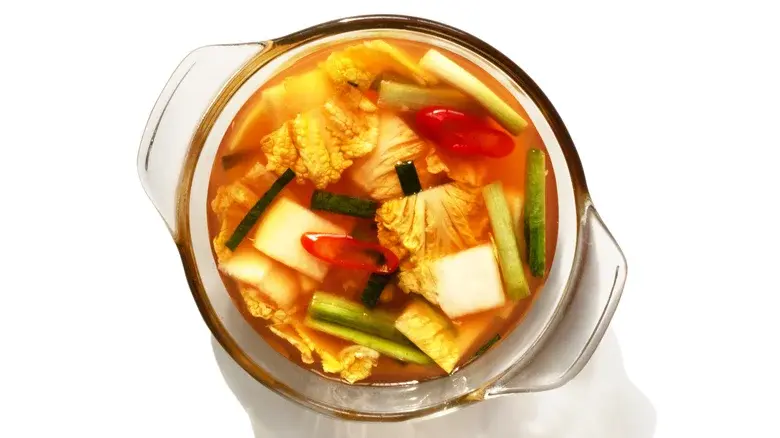
But Mr. Chang and his variations don't end there. On the Food and Wine website he gives us Mul kimchi (white kimchi) for which he uses 7-Up - a lemon/lime soda drink because:
"While I can’t speak on behalf of every Korean household, 7UP or Sprite is typically added at home to get the right balance of acidity and sweetness. Mul kimchi is white kimchi, but it’s also an example of water kimchi, where the vegetables are submerged in a drinkable broth."

And that drinkable broth is often made with
"the addition of glutinous rice flour, or sugar and pear, which adds a fruity sweetness to the kimchi brine."
And on the SBS Food website, a Korean lady called Sue Glynn makes kimchi with weetbix, although, alas, there is no recipe online. But you can go to Tasmania and attend one of her classes in making it.
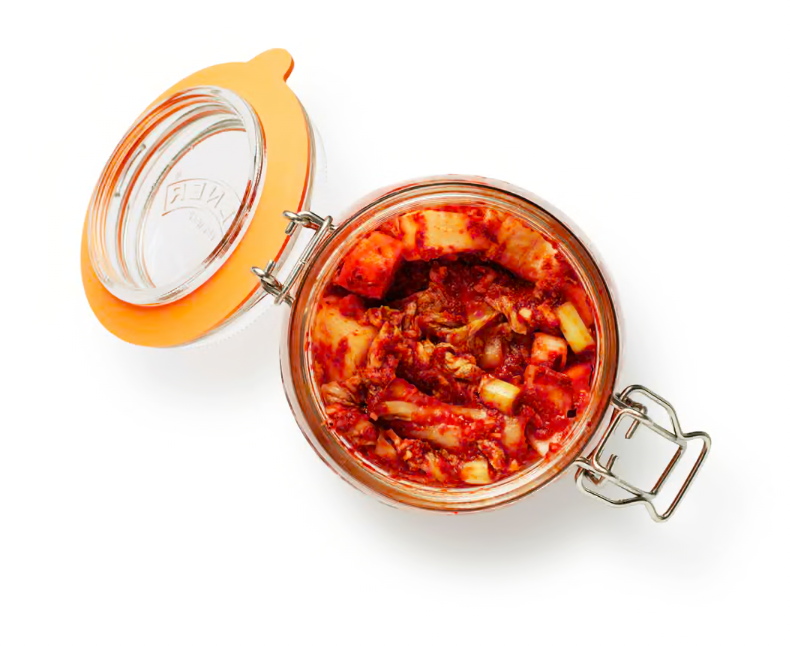
I'll give the final link to Felicity Cloake who tells us How to make kimchi not a 'perfect' one in this case and so just the recipe with no interesting comments about this and that. However she did have one practical word of advice on submerging the cabbage in the liquid in the jar:
"a clean plastic bag full of cold water should do the trick"
She also goes the water way in that the cabbage is first soaked in brine, rather than having the salt massaged into it. You drain it before adding the other stuff.
Will I have a go? I doubt it. I'll be buying mine from the supermarket. I don't use it often - if at all although I probably should. Well there is all that chilli.
It is interesting to ponder however, how specific and essential this is to Korean cuisine and how the 'everything Korean is cool' vibe has meant that the whole culinary world is now enraptured.
YEARS GONE BY
April 22
2023 - A quote
2021 - Missing
2020 - Missing
2017 - Nothing


Enraptured by Korean food but what about the "smell and the danger of explosions" ???😱