A classic in so many ways
"Along the way I was reminded of a kind of cooking which, in the pursuit of the new, I had all but forgotten. And I fell in love with it all over again." Jay Rayner/The Guardian

This is a lucky dip post. David picked out the large format revised copy of Robert Carrier's Great Dishes of the World and the page I randomly chose included a recipe for Coq au vin - accompanied by a short essay and this old-style arty photograph of the dish - well the ingredients. Although now that I look at it, it isn't quite, so maybe it's a picture of the ingredients of another of his chicken dishes. So I checked - and no - because there are no carrots in the classic as we know it. But then this is not a dish as classic as you think - well according to Wikipedia anyway:
"Several legends trace coq au vin to ancient Gaul and Julius Caesar, but the recipe was not documented until the early 20th century, it is generally accepted that it existed as a rustic dish long before that. A somewhat similar recipe, poulet au vin blanc, appeared in an 1864 cookbook." Wikipedia
I'm pretty sure it existed long before that - as Wikipedia suggests - Nigel too:
"Such a recipe wreaks of its history and its place in the life of those who invented it. You can see how the whole thing worked for them, how the dish slotted into the farmer's life, its place in the landscape." Nigel Slater

And even Carrier himself in his essay on the topic of Coq au vin, which opens his chapter on Poultry says:
"I have enjoyed chicken cooked in red wine, white wine, and even in champagne; I have had it garnished with button mushrooms, tiny white onions, lardons of fat salt pork or green bacon, croûtons of fried bread or golden pastry crescents, and even with soft-textured cockscombs ..." Robert Carrier
This is the photograph from the original Great Dishes of the World - similar idea, but different - and no carrots - but still with a bird complete with its head and all its feathers. Which is how they used to be. Even I have a distant memory of plucking a chicken in my grandmother's garden.
And whilst we are talking about photographs, I also found online a photo of one of Robert Carrier's cookery cards - see below which also included his recipe. Also a photograph with a retro feel, but difficult to say why: (if you click on the picture you can see the recipe.)
Carrier had a tendency to repeat some of his recipes in different books but he didn't tinker with them. The recipe for Coq au vin sometimes has the à la Beaujolaise bit tacked on to the title but the recipe is the same. I don't know how many times he repeated it, but I have at least three - well there were three - maybe more editions of Great Dishes of the World plus his later New Great Dishes of the World, which included a whole lot of recipes from famous chefs around the world, but also in his Classics section he included Coq au vin - the exact same recipe as in the original book.

Briefly going back to the retro look thing - here is a photograph of Nigella's white wine version - Coq au Riesling, of which she says:
"I love this photograph, a beautiful – and only slightly camp – homage to the pictures in the Robert Carrier books I remember from my youth!" Nigella Lawson
It's certainly true you don't find those gorgeous soup tureens anywhere these days, but 'camp'. In what way is it 'camp'?
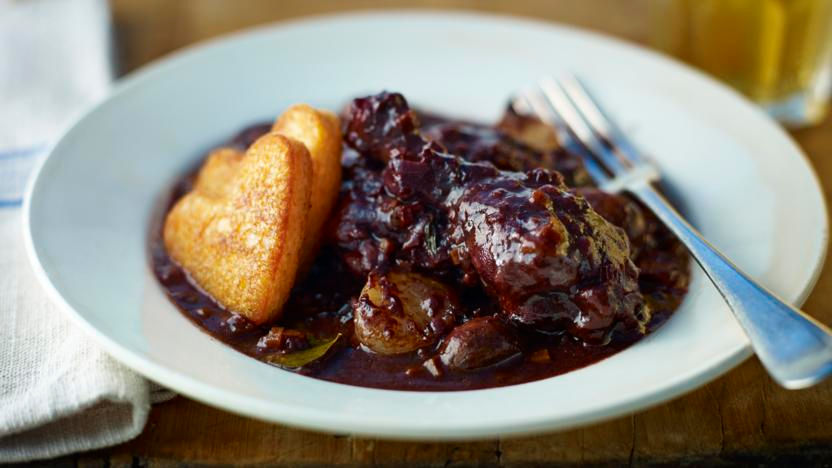
We seem to have got a bit better at it today as this Coq au vin made by Simon Hopkinson and featured on the BBC Food website shows.
Maybe those original photographs didn't actually show the dish because it's so difficult to make stews - brown dishes look good. As I was 'researching' this post I actual found one of my own long ago posts Brown but so much more which had been inspired partly by an essay by Nigella in her book Cook, Eat Repeat on on brown food but which was all about Robert Carrier - uncanny coincidence.
"No, they might not always look pretty but, gosh, do they eat well." Says Jay Rayner in The Guardian in an article in which he talks about the novel he was writing and how the food of Robert Carrier had played a huge role in its writing - they being the recipes of Robert Carrier.
All of which is really a digression from Robert Carrier and Coq au vin. Coq au vin's basic ingredients seem to be floured chicken thighs and drumsticks - not breasts - browned, and then flamed with some brandy, covered in red wine and then left to cook. Near the end of the cooking some small onions, and mushrooms which have been browned are added to the dish. It's really pretty simple. No garlic and just a few herbs. It really couldn't be simpler, although some cooks make it so of course.
Everyone has had a go at it and here I will present two recipes and videos. The first from the Canadian Jamie of Jamie and Julia who makes Julia Child's coq au vin - said by many to have started the craze for this particular dish. The second is from Felicity Cloake, who in the process of making her Perfect coq au vin also makes Elizabeth David's, version - the one at the end.
All of them somewhat brown and uninteresting looking but Jamie certainly thought it was amazing.
As did Nigel Slater who described one version from his past:
"I once worked in a restaurant that, at the time, was considered to be the best in the land. At least several of the guides thought so. The chef patron had learned to make this dish in France, he understood its roots. We made coq au vin every week (believe me when I say that this is one of those dishes that improves, rather than deteriorates, after a few days in the fridge). I have never made it better than I did under his beady eye, but then we made it with the dregs of the glasses and bottles from the customers' tables. So whether it was the quality of the local birds, the excellent wines or that soupçon of saliva from each glass that made the difference I will never know." Nigel Slater
He also says:
Where I am the first to say we should cook to suit ourselves, our intuitions and appetites, I also believe that a classic recipe should be just that, a classic. To mess around with it would be to misunderstand it, to somehow downgrade it."
And most of the cooks that I have canvassed here, do not in fact mess with it. However, the next recipe in his book is for Chicken en cocotte which is a sort of synthesis of all the ways you can braise a chicken and of which I say in that post:
For me this is the thing that makes Robert Carrier such a great cook. He takes a range of similar dishes and synthesises them into one perfect iteration that expresses the fundamental taste experience of them all. And by doing so he recalls all the dishes that have gone before, and all the techniques and ingredients, and history that has led us to that point of discovery. Which is also why you won't find the same thing today on a restaurant menu - maybe not even in France. So hang on to those old gurus and explore."

He knew what he was doing Robert Carrier, and Great Dishes of the World is brilliant. You could cook almost everything in it and I have certainly made many of them - including the coq au vin - which is now a retro dish. We should all rediscover it and give it a go, even if it does just look a bit brown at the end.
YEARS GONE BY
May 15
2025 - Nothing
2024 - Persuasion
2023 - Smidgens
2021 - Missing
2020 - Missing
2019 - Haloumi and quinoa salad
2018 - Australian olive oil
2017 - A temporary end to dieting


I like the idea of great cooks using the left over glasses and dregs of wine to make this classic dish. "Waste Not, Want Not!" as they said in days of yore! 🫠