Thickening with flour
"Once the water has bonded with the flour and gelatinised, there’s no going back." A Life of Geekery

I have returned to my sometimes series of how to thicken things - and flour.
And I am confronted with a dilemma, because, I'm sure you all know how to thicken things with flour - or cornflour and maybe arrowroot - the other contenders shown here. I'm also not really into all the science behind how cooking happens. As soon as I start seeing those incomprehensible chemical names, or diagrams of physical processes, my brain sort of goes into a lull. It does not process, and sort of tells me that I don't need to know this. So if you really want to know some of that - not in great detail I will confess - then check out this article - A Guide to Thickening Soups, Sauces and Stews on the A Life of Geekery website.
For me I'll try to ramble a bit here and there, whilst covering the four main ways of using flour to thicken things, and one less obvious one.
I will start with the roux - probably the one we all started with - in its two guises - gravy and somewhat more sophisticated things like sauces and custards.
I'm also going to chicken out a bit on the gravy side of things, because Nigel Slater has a more or less definitive article on the topic.
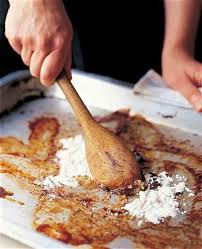
When my mother made gravy, and here I shudder a bit, she did not use flour, she used Bisto. Ironically I first learnt to make gravy with flour from my mother-in-law who unlike my mother who was otherwise a pretty good cook - was not - and was not really interested either.
I'm sure you know how to make gravy - pour out surplus fat, sprinkle some flour over the last of the fat and the juices in the roasting pan, and over the heat, stir them to combine until it's a smooth mixture. ! saw lots of pictures of people doing this with a whisk, which may well be the best way, but I use a wooden spoon - well not a spoon shaped one - one with a flat base, that I use to scrape in all the lovely crusty bits left in the tin. When everything is well mixed together, add your liquid of choice, from water to an expensive red wine. But do it gradually making sure your mixture is smooth again before you add more. Repeat until you have the right consistency. It might take a bit of time, but as Nigel says:

"I have no doubt that we should make an impromptu 'sauce' to go with our roast. The fact that meat carves more easily and stays more juicy when given 15 minutes' rest between oven and table is surely evidence enough that we are supposed to make gravy to go with it. Fifteen minutes to hang around, tantalised by a glistening roast? Someone is trying to tell us something."
But then again he doesn't really think we need flour at all:
"A perfectly decent one (I might argue the best) can be made by pouring boiling water into a pan after removing the roasted meat, then stirring to dissolve the sticky goo that has accumulated during roasting. Voilà!
So really gravy comes down to whether you like it thin or thick. Which is also true of custard - my poor mother, when we had custard, and because she catered to our tastes, rather than decreeing how custard should be - had to make a thin version and a thick version as well when we had custard to pour over our puddings.

Gravy of course, is just one example of a sauce made with a roux. Melt butter, add flour, mix, add liquid and whisk away until it's smooth and keep stirring until it's thickened. A whisk is a really good idea for this one. I used to dread making a sauce this way. First of all you have to be careful not to burn your mix of butter and flour, because you have to cook it for a while until it smells 'nutty'. That's what they all say, but I really don't know what it means, so I just go for when it starts to change colour. Then you add your liquid - bit by bit and whisk like mad so that you don't get lumps. Very tricky, and when you've added all your liquid and you've still got lumps what to do?
Well back in the day when we didn't have a lot of whizz bang electric gadgets like stick blenders and electric whisks, a friend told me to just push it through a sieve. Very good advice. These days just use one of those aforesaid electric gadgets and whisk until the lumps have disappeared. And if that doesn't work then push it through a sieve. Sometimes the low tech solution is the best.
A roux is the method you use for making a distinct and separate sauce, not for thickening something that has already been cooking. For this there are three more options.

The simplest is a flour slurry - i.e flour and water. Just mix flour and water together and pour into your stew or whatever. Well of course, it's not quite as simple as that, because you have the same problem as with a roux - lumps. So you need to start whisking as soon as you start adding your water - or whatever liquid it is that you are using - and add the liquid very slowly. You also have to make sure that your flour is all mixed in. In the past I have been guilty of realising as I get to the last bit that I am pouring in that there is still some separate flour at the bottom of the dish or jug.
So make sure it's all smooth as it should be - or pass it through a sieve. Then pour into your cooking stew or whatever, whisking (or stirring) as you go. If you are pouring it into a chunky stew then it will be rather difficult to use a whisk. Do that process slowly as well. Generally speaking however this method works pretty well.
The probably safer alternative, is to pour a little of the hot liquid in your pot into your slurry, mix it well and then pour this, now thinner and warmer liquid, into your pot.
The one drawback I think is that once you have flour in a stew there will be an increased tendency for the stew to stick to the bottom, so you have to stir it more often than you might have otherwise. This tends to happen less if you are cooking it in the oven.
Then there's beurre manié, which is the same sort of principle only it's butter not liquid mixed with flour. So a bit more cheffy and it gives a richer touch to your sauce.

Moreover it's easy. Take half and half butter and flour and mix thoroughly together until completely smooth. Knead it a bit they say. I gather chefs make it in bulk and then just take small pieces to drop into their sauces. Yes you still have to whisk it in. But yes, I have found this to work well.

Dusting - i.e. giving your meat, fish or vegetables a light dusting of flour before you cook it. I do this occasionally believing that it will make the sauce a bit thicker. The only drawback being, that tendency for the meat to stick to the pan - and therefore, eventually burn. I am now confused however - because of science in a way.
I had thought that the above was the only danger - potential burning and sticking. However, today I read this in a Guardian article from a chef - Richard Turner:
"flour gets in the way of the Maillard reaction [put simply, the chemical process that occurs when proteins and sugars in a food are transformed by the application of heat, which in turn transforms the taste of the food. Or, put very simply, browning]. Caramelised blood intensifies the flavour of meat, while browning helps it cook out properly.” Richard Turner
Well he's a chef - he should know. Not that I really understand all the Maillard reaction stuff. But then, just now, I came across this:
"A light coating of flour dries the surface. Dry meat browns better. Moisture is the enemy of a good sear. With less surface moisture, the Maillard reaction kicks in faster. That means deeper color. Richer flavor. A more appetizing crust.
Flouring meat before browning also protects it. The flour layer acts like a buffer. It slows moisture loss and helps keep meat juicy inside. This matters with chicken, pork, and thinner cuts of beef.
There is another bonus waiting in the pan. As the floured meat browns, the flour cooks too. Those browned bits stick to the skillet. Later, they dissolve into stock or wine. This is how great pan sauces and gravies begin. No extra thickener needed." The Reluctant Gourmet
I think I'm going to stick with that one. It sounds rather more plausible to me - I mean he or she is certainly right about moisture being 'the enemy of a good sear'. Not that you need flour to stop that of course. And I always find that if I dust my meatballs with flour, before frying a tiny bit and then putting into the sauce, they stay together more and have a better texture.
Last floury thickening thing - good old British dumplings - Jamie's on the left and Delia's on the right.
Not only do they taste delicious in a most fantastically homey way, but those little balls of flour, soak up the liquid so that you are left with a smaller amount of liquid, into which a little bit of the flour from the dumpling has seeped, thickening it to just the right degree. And those meatballs in tomato sauce, work in the same kind of way, although they do not suck up nearly as much of the sauce. It works every time. Not suitable for the 43 degrees it's going to be tomorrow however. I shall have to wait until winter - well autumn.
A final word on alternatives to ordinary flour - and I don't mean just wholemeal, rye, etc. I mean cornflour, arrowroot and green lentil flour (and similar). One of their advantages being they are gluten free. So just quickly, because these are things I do not use at all or very infrequently, if told to, but I learnt a little bit here.
Cornflour - won't go lumpy but don't boil it.
Arrowroot - I do have some but I really cannot remember the last time I used it. Used by chefs to make dessert sauces look transparent and glossy.
Green lentil flour - I had not heard of such a thing, but somebody asked Nigel Slater what to do with it in his answering reader's problem questions in The Guardian:
"Green lentil flour is mainly used commercially as a thickening agent in vegetarian pies and stews. It also has the advantage of being gluten-free. At home, you can use it to add body to your winter soups, making them richer and heartier. The flour adds little in terms of nutrition or flavour, but is much more successful for thickening stews than wheat flour."
Who knew? Or you could just use lentils.
YEARS GONE BY
January 26
2025 - Lemon peel
2021 - Missing
2019 - A new kind of lucky dip
2018 - Remembering Paul Bocuse
2017 - Nothing


Thickening and Dusting who would have thought?!
👍🫠😝