The sounds of silence
"a clear, definitive sound connected to your past can bring back details you might never have remembered again." Danny Wallace/The Guardian

Yes I know - this painting by Giorgio de Chirico has absolutely nothing to do with kitchens and sounds. But it started me out on this particular post, and introduced me to a series of paintings by an artist I knew little about. And honestly I don't really like his paintings, but they are arresting. I really felt I should say something about it.
So before I get to the sounds of the kitchen, some brief words about this series of paintings shown below in a mini slide show - just click on the arrows to move to the next painting. If you are interested that is. The painting above that started me on all of this is my daily painting, from an old perpetual art diary that I have retrieved.
All of these paintings depict Ariadne on the beach at Naxos abandoned whilst she sleeps by Theseus whom she had helped to kill the Minotaur and before she is rescued by the god Dionysius who falls in love with her and marries her. The god's head in on of the paintings, is not Dionysius but Apollo - and I'm not at all sure what the association with Apollo is, unless it's something to do with the sun, which shines unrelentingly on the scene.
De Chirico painted his first Ariadne paintings just before World War 1 when he had moved to Paris from Greece, where his father had been a train engineer. He was lonely and melancholy and so I guess the myth was a way of expressing that melancholy. Ariadne is depicted as a statue, because she is so unhappy that her spirit, her soul is dead - and so she has almost become a material object with no soul rather than a feeling person. Well that's some of the theories anyway. His later series painted from the 1930s to his death in 1978 and all called Piazza d'Italia are slightly more colourful but feature the same elements - monumental buildings, the statue of Ariadne, a distant train and/or boat and often two suited and hatted male figures. One critic decried them saying that they were facile self-plagiarism for money. Well I think that's what she meant.
So in all of these pictures we have an overwhelming silence, other than perhaps the distant train which is often featured, and which along with the boat depicts the passing of time - or the coming of Dionysius or the departure of Theseus - summarised perhaps by these rather esoteric words from a website called Literasophy: "a piercing quiet defies the transition of the ‘time"
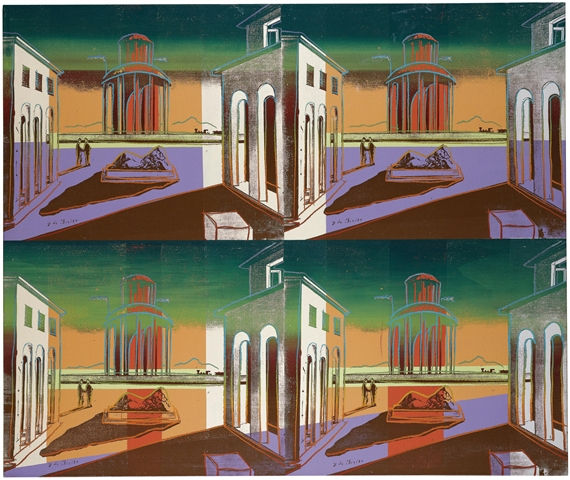
You can see from them where some of the surrealists got some of their ideas, and even more interestingly I discovered that Andy Warhol was commissioned to create a series of paintings 'After de Chirico' and one of them was this - An Italian Square with Ariadne (After de Chirico). Interesting. The same but very different. Somehow there is more movement in these, and less melancholy and creating a double sort otfmirror image, also adds another perspective. There's even the hint of the sea in that top green shading.
Enough. I know nothing about art criticism and I am definitely no art connoisseur, but I was somewhat overwhelmed by the feelings of silence, stillness and melancholy of that painting. And yes timelessness, and then discovering that there was a whole series of them was so intriguing, that I just had to present those paintings to you in case you are interested.
But how to move from an Italian Piazza - albeit a lifeless one, which is a contradiction in itself - to a kitchen which is generally a noisy place? Well a brief look at what others might have to say actually came up with some surprising connections - particularly with the notion of time.

"Recently I realised I can time travel with nothing but a glug of oil. That was all it took to throw me through the years. That glug-glug of oil ... a clear, definitive sound connected to your past can bring back details you might never have remembered again." Danny Wallace/The Guardian
There are lots of sounds in the kitchen, some associated with the food actually cooking, some of which signal that you need to move to the next phase of cooking. The sounds you should really listen for.
Then there are the incidental sounds of the actual cooking process, from removing ingredients from their places in your kitchen, their preparation, and the noise of any machines and implements that get used in the entire process. The noise of people passing by or talking nearby, the sounds of the meal getting to the table, noises of appreciation or even disgust, the clink of cutlery, the actual noise that eating creates and eventually the sound of washing up, add to this cacophany of sound. Some of those are particularly reminiscent - perhaps the sound of wine glugging out of a bottle, the sound of chips hitting hot oil. Generally speaking however, sound plays a more minor part in evoking memory than smell does it not?
And yet - this slightly different approach to sound in the kitchen, reinforces the grand notion of food as comfort - as nostalgia - as that same Guardian article points out:
"James Mansell is professor of cultural history and sound studies at the University of Nottingham. At the start of each academic year, he asks his students to think of a sound that reminds them of home. “More often than not,” he says, they think of “sounds from the kitchen. Scraping. Tapping.” The sound of care being taken. “Kettles boiling for a comforting cup of tea. Sometimes humming and singing as an evening meal is prepared.”
Which leads me to my next question about sound in the kitchen - do you like music - well any kind of sound in the kitchen as you cook or do you prefer a time of silent reflection as you indulge in mundane but sensory and repetitive tasks whilst you prepare your food? Before children I used to cook with the radio on - not news kind of radio - pop music kind of radio. I might even have tapped along with it, softly moved to its rhythm. Maybe I even sang along. I don't remember.

But I do remember that when I had busy, chatty, noisy, even argumentative toddlers with me in the kitchen I could no longer hear the music. So I turned it off. You can't turn toddlers off - and sometimes - mostly really - their general chattiness and busyness is endearing and even educational.
Nowadays I generally turn the radio on - news radio this time - just so that I have a vague idea of what is going on in the world, for generally I try not to listen to the news. It's just too depressing.
Commercial kitchens, of course, are a whole other universe, of which I know nothing.
I confess I do like silence however. Well almost silence. Silence - well background silence - is soothing. However, nowhere on earth is there true silence. The closest I have come to that is on a long ago visit to the Grand Canyon, and another visit to some fairly distant - I won't say remote - part of the Australian bush. I have never visited a true desert but I imagine the silence - as I experienced in those two places - is so deep and still, that it does indeed almost have a sound - Paul Simon's the 'sound of silence' - written with a quite different meaning, but actually very appropriate to real and deep silence. It has a sort of sound. As De Chirico's paintings of absence have a substantial presence. Weight even.
Even in the desert I imagine there is no complete silence - and I am not thinking here of the occasional aeroplane flying overhead - they seem to fly over deserts a lot. Nor am I thinking of the sound that you yourself make - your breathing, the shifting of your clothing as you move, the noise of your feet in the sand. I am thinking of natural sounds - the wind and its effect on the surroundings - birds - even in the desert there are sometimes birds and even less often, rain. And maybe such an almost complete silence would be overwhelming, heavy.
Silence is even a fundamental philosophical topic as in the question: "If a tree falls in a forest and no one is around to hear it, does it make a sound?" But I won't pursue that one.
Silence is golden they say although Christina Rosetti says "Silence is more musical than any song." but silence is, like everything, different for everyone. I deonstrated this, when, as a primary school teacher, I occasionally took the children outside, asked them to be silent, to listen and then to tell me, or write down what they heard. Different for every one. And there is so much more sound than you think that there is.

To end this ramble which doesn't really have much to say about food, I'll continue the irrelevance with this quote from Coleridge that I found along the way. Also not very relevant at all, and my photograph taken in Abruzzo in 2016 has two people not three. But the quote was lovely somehow.
"And they three passed over the white sands, between the rocks, silent as the shadows."
It has finality. Like silence.
YEARS GONE BY
April 15
2024 - Nothing
2021 - Missing
2020 - Missing
2019 - Nothing
2017 - Orange boat on blue water


Didn't like the paintings apart from the one of the two little girls and their dog working away in the kitchen. And I do like stories of Ariadne, sad though they are. 😂