Poffertjes, puff-puffs, doughnuts ...
"the yeasted drop doughnuts that many different food cultures seem to have a beloved version of." Jimi Famurewa/The Guardian

I marked this page in the latest Coles Magazine because of (a) its reference to Dutch poffertjes and (b) its mention of 'trending brekkie bites' as well as the fact that Coles has decided on this as a product to develop. I thought there might be something to investigate.
And indeed there is - well too much really. If you look up poffertjes in Wikipedia you will find at the end of the article a very long list of See Also dishes from just about everywhere in the world. And I'm not about to launch into a full discussion about them all. I will, however mention a couple.

Where to begin? Maybe with this recipe for Puff-puff pancakes from Jimi Famurewa on The Guardian website, where I was first introduced to the notion of a world-wide love of what Felicity Cloake calls:
"the myriad permutations of deep-fried joy beloved of peoples around the world."
This recipe was, after all my first website from a search on poffertjes. It came up because Famurewa began his introduction with a description of a trip to an amusement park in The Netherlands where the family indulged in poffertjes to 'soothe their jangled nerves' after a too scary carnival ride for one of their children.
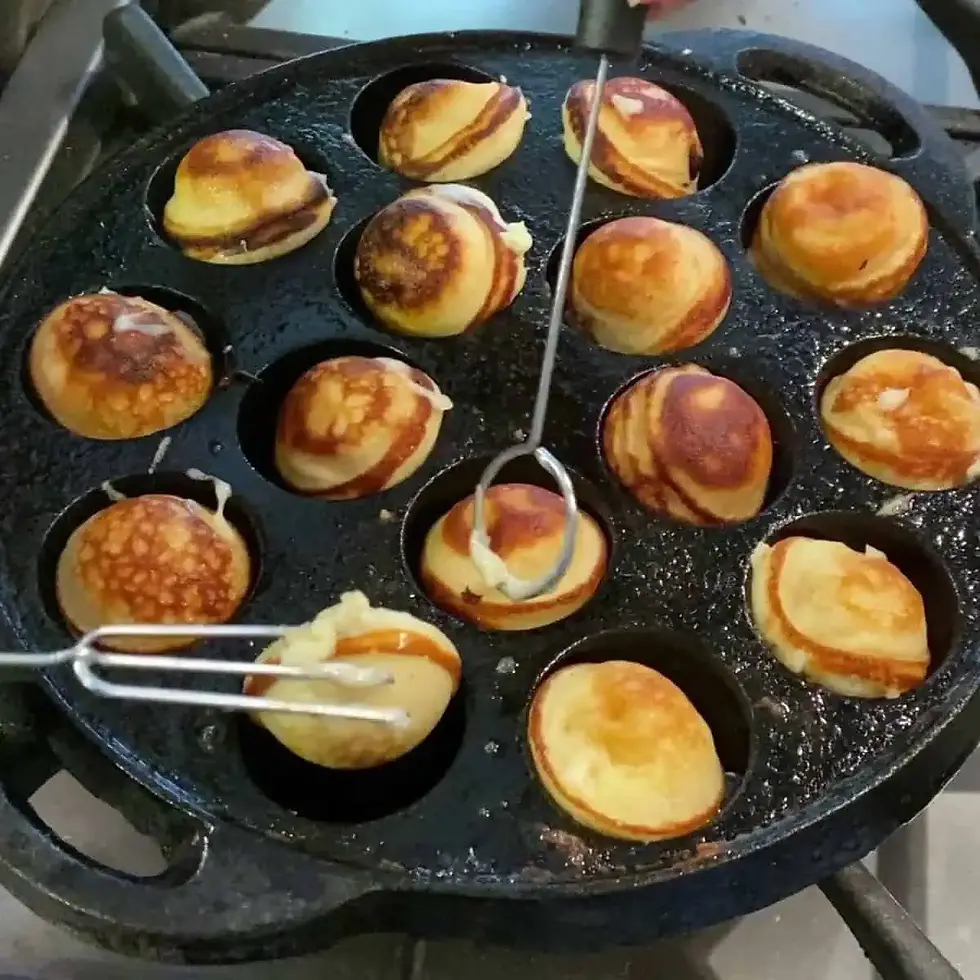
Later, when he was trying to avoid the deep-frying aspect of the Nigerian puff-puffs he turned to his memory of the Dutch poffertjes, which are cooked in a specially indented pan, as shown here. I found a rather lovely description of the mythical origins of this pan on The Daring Gourmet website:
"There are a few theories, the most popular of which is that they were created by the Vikings returning from battle with dented shields: they would place these battered shields over the fire and pour the batter into the indentations. Unfortunately as fun as that theory is, it’s nonsense because the Vikings didn’t use metal shields, their shields were all made of wood."
I think they turn up in Aldi every now and then.
Jim Famurewa however didn't have the pan, and so instead he decided to just drop small quantities of the batter into butter in a frying pan. Thereby demonstrating in one article the similarities and differences between method and ingredients for all of that myriad of permutations.
It now seems to me that it comes down to those two different aspects - the technique and the ingredients.

Just to dismiss the technique question first because it's relatively simple. Well maybe not. Number one - deep-fry - as with the doughnuts which we all know and love as shown here by Felicity Cloake with her Perfect jam doughnuts. The origin of doughnuts much popularised by the Americans of course, is also thought to be The Netherlands. And the puff-puffs of course, as well as a myriad other such things from just about everywhere.
The second is the aforesaid mould which at first sight does actually seem to be confined to the Dutch and their poffertjes as demonstrated here by The Dutch Table and Bec's Table

But then at the last moment I decided to watch Jamie Oliver make 4 ultimate pancake recipes where, using a sandwich maker and an electric waffle maker he used a pancake batter to create savoury sandwiches and a fairly classic waffle complete with maple syrup. Always fun to watch a Jamie video and this one is pretty short and looked so easy that I felt like rushing out to buy a sandwich maker, and maybe even a waffle maker, not to mention making pancakes for breakfast when we holiday in New Zealand over Christmas.

Jamie included the shallow fry method in his demonstration - as did Nagi Maehashi on her Recipe Tin Eats website, in an even shorter video of how to make breakfast Pancakes in their simplest form that is. With lashings of the maple syrup from America.
Jamie's last option was to thin down the batter, and make crêpe-like pancakes with lemon and sugar. The kind of pancake that we British love, especially on Pancake Day - Shrove Tuesday to the religious, when we make feeble attempts to toss the pancakes without them either sticking to the pan, landing all folded over or landing on the floor.
Enough of the technique. There are probably others that I have not looked at.
What about the ingredients? Here the basic differences are the kinds of flour used, a rising agent - yeast, baking powder, self-raising flour, baking soda or none at all. Not to mention, eggs, milk, spices ...

The doughnuts, of course, include yeast, and so do the African Puff-puffs shown here on the Immaculate Bites website which gives them their puff.
But really it's only the kind of flour used, and the mould, that differentiates them from the original poffertjes, which JImi Famurewa describes with such pleasure:
"Made to order in a vast, uniformly indented pan, speared through their light, custardy middles with toothpicks and served with a thick swoop of pale butter, they always prompt an acute, grunting sort of shared pleasure and succour."
A bit like Nigel's burnt toast in a way. Although not so much a comfort food as a festive one.
Also a food of the poor, because the traditional flour used is buckwheat flour - the flour of the poor because buckwheat will only grow in poor soil, which only the poor will need to cultivate. These days they are mostly made with a mix of buckwheat and white flour - if you are trying to be at least a little bit authentic that is.

We often disregard Dutch food, and consider it inferior - a sideline in world food. But we forget how many of their foods spread throughout the world - first with their colonial exploits - the Indonesians in particular have something called Kue cubit, which looks a little similar to poffertjes and are cooked in the same kind of trays - but decorated it seems with chocolate sprinkles. But then they are Dutch as well aren't they?
And then of course Dutch immigrants - particularly in America - like all immigrants - took their food with them. It's what we do when we travel. We might like to try the food of the country we are visiting - but not always. And I do remember the French inhabitants of a tiny village in which we once holidayed, telling us that the Dutch, who owned many of the holiday houses there, had a truck visit once a week with supplies of Dutch food. Which did not endear them to the French of course.

However, as a last completely different thing, but very closely related to poffertjes in Holland there is a group, supported by donations and grants from various bodies, who sets up a Wastebar at festivals and events, serving poffertjes for free in return for cigarette butts picked up from around the grounds. Apparently they have collected millions of them in this way - and plastic litter too.
“It turns something abstract like littering into a visible, collective social activity. People see others participating, talking about waste, picking up cigarette butts together and contributing to something tangible." Reint Jan Renes

Now they are looking at ways to recycle them. Somebody already created an artwork with them. Which is sort of recycling I guess but not quite what they mean by recycling.
So many of the names of these delicious little things - puffards, puffets, bollebouches are similar because:
"Their name comes from the way these small pancakes act once you turn them over: they puff up" The Dutch Table
It would be disappointing if they didn't puff up wouldn't it? Though I guess you could drown them in maple syrup to ease the pain.
YEARS GONE BY
September 21
2025 - Duck
2024 - 'Eat' - marmalade chicken
2022 - Holiday's end
2021 - Missing
2020 - Missing
2019 - Nothing
2018 - Nothing
2017 - Quinoa
2016 - Smell - the underrated sense


I'm sure I had a poffertjes pan once - only kept my gem irons at the last move...We made Dutch doughnuts "Oliebollen" at my daughter's Steiner School fete in the 70's
All this puffed up delciousness looks wonderful but has less obvious health claims! 😇