Is there more to Jamaica than jerk?
"Out of many, one people" Arawak people - Jamaican motto

I have been neglecting my tour of the world in food. Perhaps I was beginning to think that going around the edges and into the Caribbean was becoming very much same old, same old - lots of fish and lots of rice and beans perhaps. But this is actually not true - you'd be amazed at how many different ways you can cook rice and beans, for example. And anyway next on the tour is Jamaica - the third largest island of the Caribbean, a place whose national motto - form the original Arawak people is out of many, one people. And out of those many peoples, comes one distinctive cuisine, with at least one dish - the jerk - which is completely unique.
Who are those many peoples? Well a mix from the original Arawak/Taínu peoples who first came there around 200AD, to a few remaining Spanish leftover from the original conquest by Christopher Columbus himself, the British who eventually drove the Spanish out - well the English really. There was no Great Britain at the time. Then came the African slaves who now make up around 70% of the population - well above the next groups which include the Irish, Scottish, Chinese and Indian indentured labourers who replaced the slaves on the sugar plantations, when the slaves were emancipated.
It's now Independent - since 1962, but still part of the British Commonwealth, so has a Governor General just like us, who represents King Charles - so technically it's a constitutional monarchy. Also today the Jamaicans have also spread around the world - particularly to Britain, the USA and Canada, taking with them their food, their music, their sporting prowess, and their good nature. Even a religion - Rastifarianism - and its associated reggae music and veganism.
A few dates from that brief history - Christopher Columbus arrived first in 1494 and claimed it for the Spanish. He returned in 1503 but was shipwrecked so that he and his crew had to remain there for a year before being rescued. In 1655 the British (English) took Jamaica from Spain and then in 1838 Britain emancipated the slaves who worked on their mainly sugar plantations, and so in the 1840s is when those indentured labourers began to arrive.

I should also mention the Maroons - a group of people living high in the mountains in the interior consisting of a merging of the original natives escaping from the massacres and the diseases that decimated their people, and escaped slaves. From this merging comes jerk which, as well as its unique flavour was cooked in the ground, so that the smoke did not betray their presence. I have written in much detail about jerk - specifically jerk chicken before, and included a bit more history as well as recipes.
"It is said that the native Taino Indians in Jamaica developed the cooking and seasoning while the Maroons introduced the pit that it was cooked on. This would be the truest Jamaican dish since it was formed on the island." Shannon S. Evans
I'm pretty sure that if you mention Jamaican food, the first thing that springs to mind is jerk chicken, but, of course, as well as the fact that other meats, fish, even vegetables can be cooked the same way, it is not actually considered to be the national dish.
The national dish is Ackee and saltfish which at least one writer I came across said was an 'acquired taste'. And I have to say that it is a mix of two unpreposessing ingredients - saltfish - which needs to be well soaked to remove the saltiness and ackee - an African fruit fed to the slaves which is toxic if eaten too soon. So the safest way to eat it is actually from a tin. According to another writer "the fruit has a beautiful texture but is largely tasteless" and when cooked has a texture resembling scrambled eggs. Jamaica is in fact almost the only place in the world which now eats ackee. So you really would have to wonder why it is a national dish.
Before I get on to specific Jamaican dishes a few words about ingredients. There seems to be agreement on what the archetypal Jamaican ingredients are:
"I’d argue that what truly creates the unique taste of Jamaican food is the use of scotch bonnet peppers (no, you can’t sub habanero peppers), thyme and pimento."' Shannon S. Evans

Add to that spring onions for 'the holy trinity' of spring onions, thyme and garlic. But yes - the Scotch bonnet pepper is definitely the thing. But then there is this from George Stern of Serious Eats when writing about Jamaican ingredients:
"Jamaicans use a lot of cans. Between the outsize influence of the British—our most dogged colonizers, and still the tinniest people that ever did tin—and the storm-prone, bug-blessed reality of tropical living, canned goods have emerged as the understated, unglamorous backbone of Jamaican cuisine."
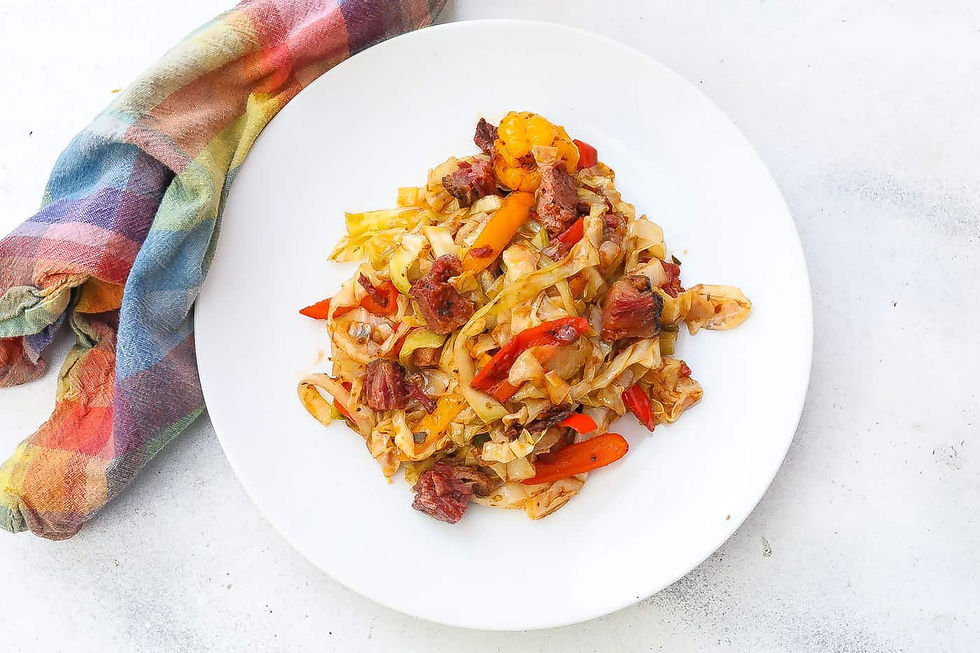
Witness Corned beef and cabbage (this recipe from a Jamaican cook - Food Fidelity) who has, however, poshed up the recipe by using real corned beef when actually the real thing uses corned beef from a can - which we used to eat as kids - I used to like it. It's a simple and cheap dish, whose origins are obviously British - if it weren't for those Jamaican flavourings of allspice, thyme and Scotch bonnet.

I mentioned rice and beans - so what is so special about Jamaican rice and peas (Healthier Steps) as they call it. Well the name for a start - normally this dish is called rice and beans - well the 'peas' are actually beans - in this case red kidney beans. Then the rice is cooked in coconut milk, which would change the taste fundamentally. The final thing is the inclusion of most of those Jamaican essentials - allspice, thyme, spring onions, onions and ginger with the inevitable Scotch bonnet dropped in to add spice. Two basic ingredients - rice and beans - and so very many different ways to cook them. Because, I suppose, they are basic foods everywhere - except perhaps Britain! In the case of Jamaica it comes from the very cheapest food to feed the slaves with.

Curry goat seemed to me to be the next most mentioned dish and yes, the proper way to name it is 'curry goat' not 'curried goat' or 'goat curry'. The recipe I have chosen here is from a website called Immaculate Bites and I chose it because although the recipe includes curry powder - but Jamaican curry powder, which you are unlikely to find here she also has a recipe for Jamaican curry powder. Well, unlike Britain we don't have a lot of West Indian immigrants here - which is interesting is it not? What is different about Jamaican curry powder? Well it's got allspice and scotch bonnet in it, and also more turmeric and is generally milder than other curry powders. I didn't see a single recipe that suggested using lamb instead of goat - but you can get goat here and there - the Queen Victoria Market for one. This particular writer said that before she tasted Curry goat, Jerk chicken had been her favourite Jamaican dish - now it's Curry goat. That's some recommendation. We all love jerk chicken don't we?

Beef patties (Orchids and Sweet Tea) - are a real mix - in that there is the shape - similar to a Cornish pasty or a Latin American empanada - but they are bright yellow because of the inclusion of turmeric in the heavily buttered pastry. And the beef has all those usual Jamaican flavourings.
It's Jamaican street food, but beef, although the most common filling, is not the only one. They can be stuffed with anything else - including that ackee.
I'm guessing that jerk chicken is street food too.

I mentioned at the beginning of this post that Caribbean recipes were often all about fish, but I have only come across one fish recipe in Jamaica - Escoveitch - well spelt slightly differently in Ainsley Herriot's recipe for Mackerel escovitch. (Well I had to include at least one of Ainsley Herriot's recipes I guess because of him being the poster boy of Caribbean cooking.) The name is similar to the Spanish dish escabeche - a cold dish of pickled fish with capsicum, etc. And so this is a dish from that centuries old Spanish lordship. However the Jamaicans do things differently. They do indeed pickle the fish - but the pickle includes allspice and a special salt with those typical Jamaican flavours - and then they fry the fish before dressing with the shredded vegetables that were in the pickling liquid. Ainsley Herriot grills his fish, but most of the pictures I saw, left the fish whole and fried it.
What else? No detail here, just a list and some pictures - Callaloo- a particular kind of African green which is cooked with the usual suspects and served as a side dish; Bammy - a kind of bread made with cassava; pepperpot and oxtail - two more stews; rundown - a breakfast dish of salted mackerel cooked in a kind of coconut custard and served with boiled green bananas and cassava dumplings (sounds revolting to me - and doesn't look much better); Stamp and go - salt fish fritters.

But I really shouldn't forget Jamaican rum - particularly white rum. Rum was one of the first things I came across when I started to look into Jamaican food. There was an informative article in The Guardian - Rum is booming but only Jamaican classics have the true funk about a return to Jamaican rum to combat the current craze of spiced rums - which the writer described as
"a generic, sweetened spirit mixed with aggressive vanilla, much of it fit only for knocking back pre-amputation."
whereas he (Richard Godwin) describes Jamaican rum - well one of them thus:
"Hampden’s signature 1753 blend, for instance, has rich tropical fruit, deep baking aromas, nail varnish, glue, Marmite, leather, spice, animal spirits."
The first distillery in Jamaica dates back to 1749 with the Hampden's distillery mentioned there beginning in 1753. For decades most of Jamaican rum was exported, and then blended and aged in Europe but in 2016 it got one of those Geographic Indicators awards and is returning to its foundations. Which include unique processes such as the Dunder pit and at Hampden:
"they also use muck, an outrageously smelly, semi-sentient soup containing countless billions of yeast bacteria, plus various bits of decomposing, well, stuff."
Not very enticing but rum is indeed popular. It very possibly was made by the slaves on the sugar plantations - rum is fermented and distilled sugar - although it would have been the British colonialists who commercialised it.
Tourism is today's largest earner for Jamaica - and food is a large part of tourism and indeed, in this case may well have been a contributing factor in tourism's growth.
Maybe I should make some jerk chicken soon.
YEARS GONE BY
July 20
2024 - Inertia
2023 - Bee or fly? Real or fake?
2021- Missing
2020 - Missing
2017 - Renewal in the bleak midwinter - back from holiday and post-holiday tasks done
2016 - Fasting


Not sure about this part of the world, especially the part dominated by Rum. But the beef paties look delicious! 🤔 🤗