Handwritten
"a small labour in these copy-and-photograph times." Rachel Roddy

She means copy and paste surely?
Yesterday I was a bit uninspired and so I started looking through the Ideas pages in my little notebook of various nudges into blog posts and there at the top of the page on the right is an idea from Rachel Roddy, which I wasn't really up for yesterday, although I did check out the article, which was, as always with her, an interesting one. So today, having survived the threat of torrential downpours in the night which might have led to flooding, and which didn't happen, I have decided to pursue it.
As you can see my ideas are handwritten. Others, more up to date than I, may well have this sort of thing on their computer in Notes - or some such. Or even more likely - on their phone. As you know I don't even keep an appointment diary online - I have a desk diary. My excuse is my age, but not because I'm not technically up to it. It's more that, for me at least, it is actually faster - and less likely to be deleted by accident - if I write it down. I could write on the sadness of nobody writing letters anymore - including me - or keeping notebooks. Everything we do - well almost everything - is done online, and when we are gone, all of that will disappear as well. Our lives will no longer be quite as discoverable by our descendants as they are now. Not even the photographs we take will be readily available in print.
However, today I'm writing - taking my cue from Rachel Roddy - about recipes. Although I will add to her musings on handwritten recipes by also talking about writing in recipe books.
A while ago now I wrote a post about commenting on recipes by writing notes in cookbooks. Something I had never done up to that point. But I was inspired by what I had read about it, and now try to comment on new recipes to me. Even if they are not in a book, but just downloaded from the net.

This is an example from the OTK book Shelf Love. It's Kale pesto strata with Gruyère and mustard - a kind of savoury bread and butter pudding, made with kale. I see I gave it 3 1/2 stars saying that it was "actually nicer than I thought it might be". However as I read on I saw I was reading a tiny story of improvisations, mistakes and substitutions in the kitchen which meant that the finished result was very probably not how it was meant to be, although this book - written during COVID was very big on 'making do' with what one had. Every recipe even had a space for suggested substitutions, etc. On the next page for this recipe - a page with several photographs demonstrating the process is that space, in which I have written nothing.
So what did I do differently? Well for starters I didn't use kale - it was silver beet with some pak choy which I must have had in the fridge. Which probably changed the texture, at least, slightly. The bread was supposed to be sourdough - and some of it was - but some of it was Turkish bread - so if you had a fine tasting palate, that also might have made a difference to the taste. But there is more to come on the taste spectrum - I had no oregano - so I substitued mint and some sorrel from the garden. I note at the top that the mint dominated a bit - so that probably wasn't a good substitute. I might have done better to use dried oregano. And to conclude on the taste - no Gruyère - it was cheddar. Oh - and a green chilli instead of a red one, which I don't think would have made any difference really.
So much for the substitutions which probably changed the flavour a good deal. What about the mistakes?
Well, for me, there is always at least one - and the most usual one is the one that comes from not noticing the 'set aside some of ...' instruction that so often appears in recipes. In this case it was the kale (silver beet/pak choy) pesto which all went into the basic dish. I had to make some more for the topping at the end.
I haven't made this one again as yet, but perhaps I should because it might be quite different if I followed the recipe exactly or would it? And I might not even notice my own note about not setting some of the pesto aside. However, I am so glad that I now make these notes. For one thing if the recipe was a failure - it does happen - through no fault of my own - then the note will remind me not to try again.

As here - a few pages on I scream at myself in capital letters 'DAVID DID NOT LIKE THIS!', although I see that here and there there are sort of suggestions as to how it could be improved - 'too much pasta, not enough tomato', 'needed a bit more water' ... which to me implies that I was thinking that I should give it another go some time.
My point is, I think, that not only do these notes give practical information and advice, but they also recall the occasion when the dish was made - I always date it, for example and tell myself who I made it for. David in that last case.
"Recipes are only recipes, but they can become fixed points in our lives around which other things move: with them, we can measure time, places, people." Rachel Roddy
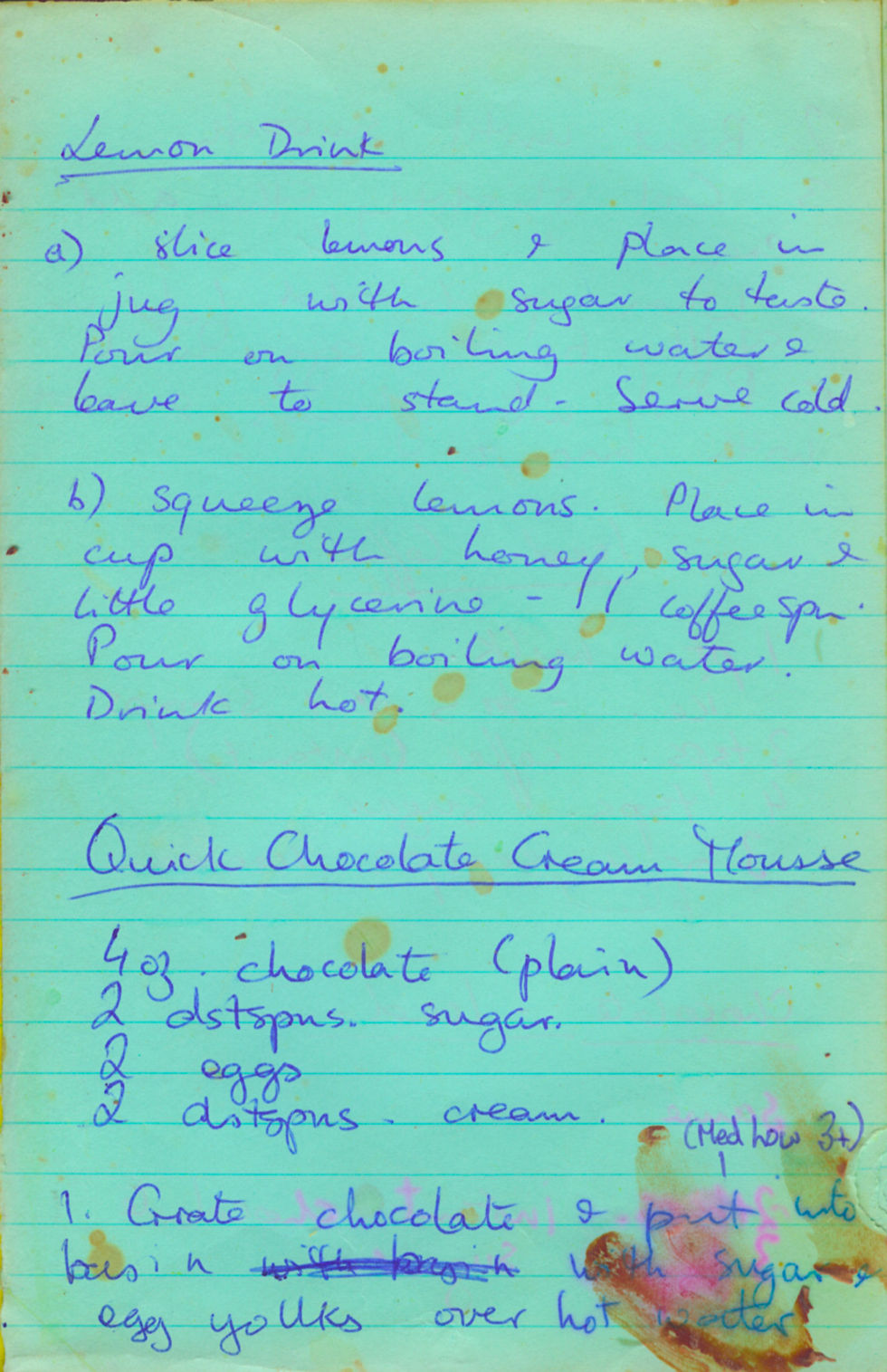
So what about those hand-written recipes that you might have tucked away somewhere? Back in the day I kept a little notebook of recipes from here and there. Most of them have never been made, but they at least tell me that at some point in time I thought them worth noting down. I wrote them.
My writing is not very wonderful as you can see and a mixture of old-fashioned styles, and more current ones. My English teacher at high school once described my handwriting "as if a spider had dipped itself in ink and crawled across the page", which is very descriptive but not very kind. Hence my life-long memory of the exact words. But mostly it's legible I think.
Unless covered with smears of chocolate, because this is my go to chocolate mousse recipe - the rest is over the page - given to me by my late and lovely sister-in-law Jenny, who was not really a good cook.

But this works every time, and over the page I note that I sometimes add some orange juice for a different taste. Or orange liqueur on special occasions. But the thing is - every time I make chocolate mousse I think of Jenny and everything about Jenny.
"if the recipe becomes part of my cooking life, it is no different from a recipe from a book or famous chef: it absolutely must have that person attached to it, like a name tag sewn into a collar. Then, every time the recipe is made, the person and your relationship to them, whatever it was, is remembered." Rachel Roddy
Has my handwriting changed over time? A little I think - slightly less legible now - but never distinctive. I found this quote today which gave me pause for thought:
"Like seeing a photograph of yourself as a child, encountering handwriting that you know was once yours but that now seems only dimly familiar can inspire a confrontation with the mystery of time." Francine Prose
Although I think it's more what was written than the handwriting itself that gives you the sense of time passing. Like some Russian homework I found from my university days. Pages in Russian script - which I can barely decipher into sounds now, let alone translate their meaning. Did I know all that once upon a time?
Then there are the recipes that I have received from others - at my request I assume. Which is curious because I have not made most of them myself. Another interesting thing is that they are mostly cakes - and I suppose I don't make cakes very often. But I can't bring myself to throw them out because of that reminder that somebody gave them to me. And yet, only one of those below - the top one on the left - can I associate with a person - also sadly no longer with us - but a remarkable lady and a huge influence in my life when it came to bringing up - or teaching - children and also because of her almost relentless cheerfulness. Everybody loved her. And she deserved it. Even her handwriting was distinctive.
And even though I cannot now remember who wrote - or typed - those recipes I cannot bring myself to throw them out because - as Rachel Roddy says:
"Sharing a recipe is an open-handed act, one made even more tangible if the person sharing has taken the time physically to write it out, maybe with notes, which is a small labour in these copy-and-photograph times."
Besides it gives me time to wonder who was Aunt Eleanor, whose recipe for coffee cake I was given. Nobody in my family that's for sure.

I will finish with Freda Coleman's marmalade cake - the recipe that Rachel Roddy featured in her article, although it was not the one that inspired her thoughts. That was an anonymous recipe, written on a scrap of paper which had been used as a bookmark and had fallen out of the book - a recipe for a ring cake that she remembered being given when first moving to Italy, but for which she could not remember the author.
The marmalade cake, therefore has more memory attached because:
"Freda Coleman was a neighbour in the late 1970s, and her marmalade cake marks the margarine years. ... Recipes are only recipes, but they can become fixed points in our lives around which other things move: with them, we can measure time, places, people. Freda’s cake – now our family cake – is one such recipe."
So at least I shall continue to write notes against new recipes that I try. And maybe I should make Faye's chocolate cake next time I need to make a cake.
YEARS GONE BY
March 2
2024 - Swifties
2023 - My ten go-to dinners
2021 - Missing
2020 - Missing
2019 - Nothing
2018 - Mango lassi in Northcote
2017 - Nothing


Now Marmalade cake..... I will be a starter from one! 😜