Sweet and sour pork
"its fame has spread worldwide for the very simple reason that it hits all the right notes, wherever you are. Savoury and crunchy, sweet and tangy: it’s addictive stuff. Treat with caution." Felicity Cloake
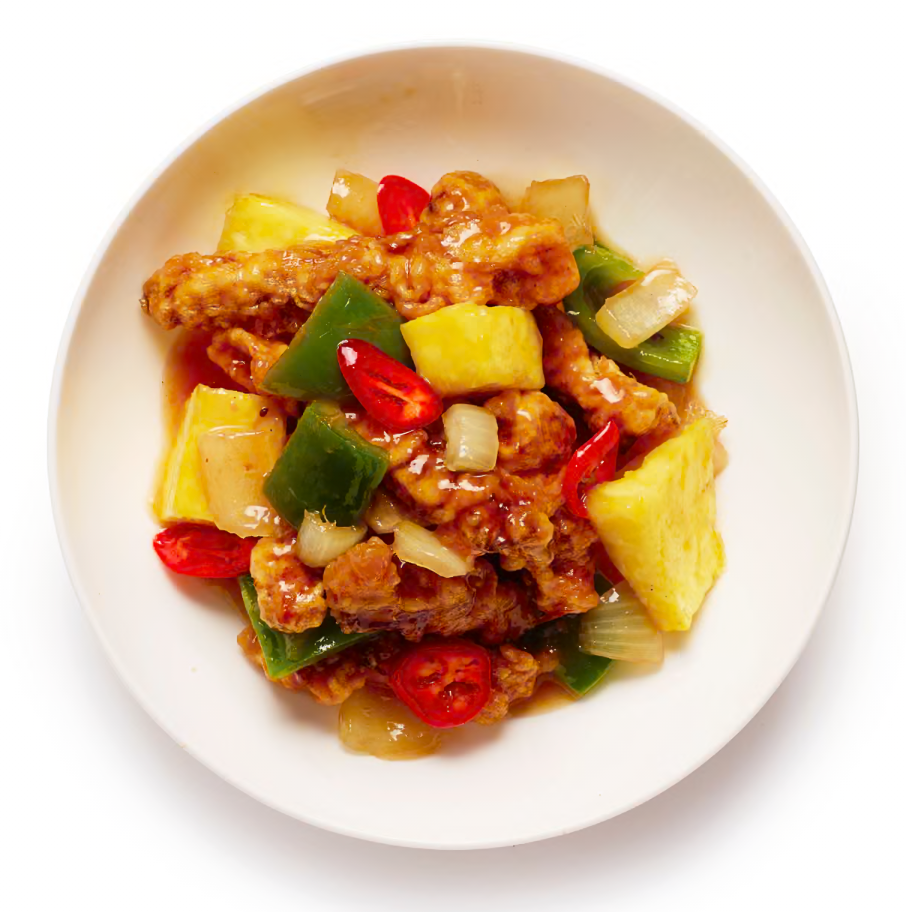
Sweet and sour pork may well have been the first Chinese food that you ate. I think it was mine anyway - although I suppose it could also have been lemon chicken, chow mein or chop suey. And it probably wasn't all that good but as my Felicity Cloake quote at the top of the page in the introduction to her recipe for the Perfect sweet and sour pork says 'it hits all the right notes wherever you are.'
I guess it has a reputation as a bastardised Chinese dish, ruined by the west and basically junk food. But junk food, almost by definition is pleasurable because junk food is consumed by the 'uneducated' masses, not to mention guiltily by the rest of us, and is therefore bad. Junk in terms of food anyway is really a synonym for popular isn't it?
However it's apparently a real Chinese dish - from the 19th century and from Guangzhou province - whose capital city of the same name used to be called Canton:
"at the center of the Guangdong–Hong Kong–Macau Greater Bay Area, the most populous built-up metropolitan region in the world." Wikipedia
And the name Canton lingers on when we talk about Cantonese cooking - or language come to that. But then the Chinese probably never used the name Canton anyway.

But I stray. Back in China the original dish was somewhat different to the brightly coloured pineapple and greenn capsicum enhanced dish we see today:
“In the old days (way before the internet), sweet and sour was not red in colour at all, as it was predominantly made up of vinegar, sugar and dark soy sauce." Jeremy Pang
Fuchsia Dunlop's recipe for Hangzhou sweet and sour pork on the Foodie Joanie website is the most 'authentic' that I found, but as Jeremy Pang goes on to say:
"However, with the heavy influence western culture now has, the Cantonese have found that ketchup provides the perfect balance and wrapping consistency for this dish. Who’s to say this recipe upgrade isn’t just as authentic as the old ways? As with any culture as it changes and adapts, it doesn’t make its expressions any less authentic; it just makes them a product of the times.”
The Chinese also discovered pineapple, which seems to be crucial these days, whether tinned or fresh.
Another ingredient for the original recipe was the juice of Chinese hawthorn berries (shanzha)
which are not available here. Well I have hawthorn trees in my garden and they line the roads here and there and they do have berries - which we do not eat, although the rosellas love them. But then the Chinese discovered ketchup which is slightly less bitter and provided the right amount of tang. However, Feliticy Cloake tells us that her local Asian supermarket told her that:
"apricot jam mixed with cranberry purée ... with a squeeze of lemon juice, makes something that, while certainly not 100% the same as shanzha sauce, is pretty close”.
Moreover after trying various other options instead of the ketchup she found that
"most popular of all is the jam mixture, which has a fruity depth to it that the others lack, with a distinct berry sharpness from the cranberries."
The other main source of controversy - or at least difference - was whether to use a batter or a double flour coating. In search of perfection Felicity Cloake eventually decides in favour of a batter:
"dusting the meat with cornflour to help the batter stick, before dunking it into a “nice, thick” flour-and-egg mixture, and finishing off with a final layer of cornflour to “get that classic sort of gulurou [sweet and sour ] shape and texture”. Felicity Cloake

But I have to say that most of the Chinese recipes I looked at went for the double dredge of cornflour and plain flour. The problem with either approach, even if you get a really crispy coating - and by the way the general opinion was that you needed to fry the pieces of pork twice - the general opinion was:
"The pork Is crispy without sauce, but once coated, it stays pretty crispy for around maybe 5 minutes, then after that you’re left with the coating the sauce clings to but it’s not as crispy anymore." Nagi Maehashi/Recipe Tin Eats
And I have to say that her recipe for Sweet and sour pork looked delicious, although maybe a bit glutinous, and the recipe itself was full of helpful information about each step of the process.

Kylie Kwong's Sweet and sour pork sidestepped the crispy problem by serving the sauce separately from the pork. She also served it with some of her Goong Goong pickles so I guess it's then up to her restaurant customers how to tackle the crispy problem. The rest of us just have to eat quickly.

Going back to origins and starting with the name - I saw three interpretations of the Chinese name's meaning - the name being 'gu lou juk' or 'gu lao rou'. Tony Tan seemed to think that: "Its fame is such that the Chinese call it gu lao rou, meaning pork with a long history." His Sweet and sour pork shown above was featured on The Gourmet Traveller website, along with his personal associations with the dish.
But elsewhere - and apologies I'm not sure where from - possibly Wikipedia - I found:
"Together, gu lou juk means meat that makes people salivate or "gulp and swallow". In Mandarin, the word is pronounced gu lu rou, with the same meaning. Another theory is that the name is derived from gu lao rou, which means "ancient meat", referring to the dish's long history"
The latter being Tony Tan's interpretation. And let's face it there are lots of languages in China.
Many people, however, seem to think that the dish is a Chinese/American dish and not Chinese at all - probably because of the pineapple and ketchup:
“The mysteriousness in this dish is that essentially it doesn’t involve any ‘Chinese’ ingredients, It’s a dish that has allowed a lot of immigrants to survive.”
So I'll end with two Chinese Americans' versions: Sweet and sour pork - Bill/The Woks of Life and Sweet and sour pork - Qi Ai/Serious Eats
It's certainly colourful and was an interesting surprise to my young self. And I have to say that virtually all of the genuine Chinese recipe sharers were almost all reminiscing about the dish they ate at home and in restaurants and from street stalls in the Hong Kong of their youth. A comfort food that reminded them of home.
YEARS GONE BY
September 5
2025 - Nothing
2023 - Morning sickness
2022 - Why do we photograph food?
2021 - Missing
2020 - Missing
2019 - Nothing
2016 - My names


Comments