Supper and how to write a recipe
"Supper is simply the comforting end point to which the whole day has been leading." Bee Wilson

A subtitle to this post might also be "why I love Nigel's recipes"
What's the connection with supper? Well I'm down to my last few bookmarked pages in Nigel Slater's Tender volume 2 so today I decided to deal with one of them which is a recipe entitled "A supper of courgettes, tomatoes and basil" - to which I shall return - but it's also one of the reasons I love his recipes - the addition of that simple word 'supper' which conjures up a a feeling of warmth and comfort - as well as an image from the past - but not of courgettes.

Nigel bangs on about 'supper' quite a bit - and when I think about it so does his friend Nigella Lawson. With her, however it's a different image of supper - she in her posh home in London, raiding her fridge for something indulgent, maybe even wicked, just before she goes to bed.
But what does supper really mean? According to the Cambridge English Dictionary it means 'a small meal eaten' late in the evening, but it's much more complicated than that - and very class conscious as I have since discovered. I mostly gleaned the general drift - which the a Guardian article sort of admitted was confusing - from a compilation of views from various British celebrities, summed up by its title Tea ... or is it dinner or supper? from The Guardian. And I will herewith say that I am talking about supper as defined and practised by the British - because that's what I know about. One writer mentioned that supper did not really exist in America, and I'm not sure it does here either, so I'm sticking with the Brits. The word derives from the:
mid-13c., soper, "evening repast, the last meal of the day," from Old French soper, soupper "evening meal," noun use of infinitive soper "to eat the evening meal,"
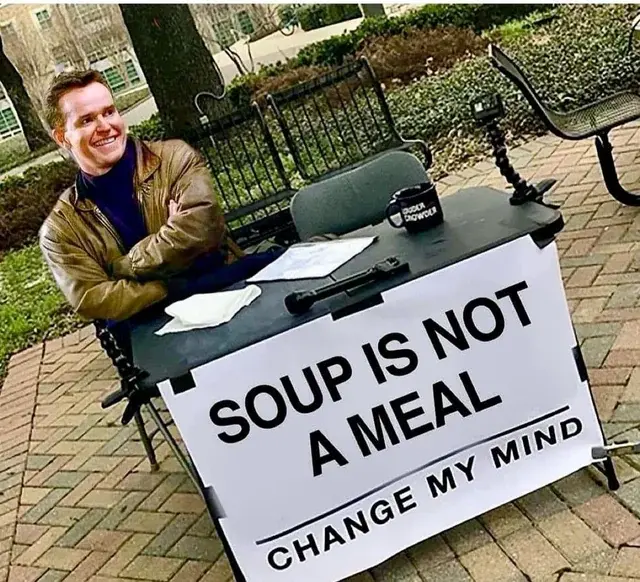
In English we also have the verb 'to sup' which technically means 'to eat' I think although we are now veering towards 'soup' which is liquid.
And here is my chance to insert this photograph which I found a week or so ago when looking for something else. I thought it worth retaining and using somehow. And weirdly here's my chance, because it's sort of an appropriate thought in etymological terms at least.
What I think of as supper is exactly what the Cambridge English Dictionary said, and it doesn't happen in this house any more. Well it never did. However, in my childhood my dad - when he was at home - would make we children a supper of a cup of cocoa and a sandwich of cream crackers - remember them? - and Cheddar cheese. It was a way to signal that it was bedtime I think. A last treat. And you know I cannot now remember whether my mother continued this practice when he was away at sea. Maybe not and that's why I remember them because they were special.
The end result, however, is that I think of supper as being late, and also pretty basic but designed to bring comfort before bed.

However it seems that this late night meal - for meal it really was/is - is actually a sit-down meal involving more than one course and wine. Or alternatively in the right circles it's an alternative word for 'dinner.'
I suppose the only equivalent kind of thing I would recognise as supper is a meal after a late night film or show in a nearby restaurant. Not the kind of thing that 'ordinary' folk would do.
At the end of that Guardian article, Stuart Heritage who had presumably compiled those interviews, sums up supper thus:
"The guidelines: Supper
When? 9pm, or later. What are we eating? Something light and self-consciously rustic, usually cooked in a bloody Aga or something. Who's coming? You, Rebekah Brooks, David Cameron and, indirectly, Robert Jay QC. Topics of conversation Chipping Norton, NewsCorp's BSkyB takeover bid, whether or not Dave can lend you a horse. Tableware Silver cutlery, ironed tablecloths, goblets full of children's blood. Dress code Top hats left at the door. We're all in this together, remember." Stuart Heritage/The Guardian
Somewhere in between that and my cup of cocoa and cream crackers, is Grayson Perry's "Supper is elegant sufficiency" . However, there is also the confusion of tea, supper and dinner being words that are all used for the main meal of the day - depending on who you are - as Tim Parker-Bowles puts it: "They have tea, you have supper, I have dinner."
Now I suspect that Nigel is not exactly posh, but very definitely middle-class, mildly snobby - about food anyway - in the sense that it has to be high quality ingredients whether grown by yourself, from your delivered vegetable box and your own butcher to farmer's markets. The rest of us shop in supermarkets, and, bless him, so does Nigel sometimes. Wherever he shops he does however often refer to supper - by which I think he perhaps means a lightish dinner in the evening. A quiet, calm time whether alone or with friends.

So back to my recipe A supper of courgettes, tomatoes and basil which I found on the web on Robin Ellis' website. There is no official recipe online, but herewith fragments of the recipe and reasoning as to why I think it fulfils the task of writing a recipe that will entice you to make ithe dish being described - even if you might not actually be sure at which meal - tea, dinner, supper - maybe even lunch or brunch - you would eat it.
Of course we are helped by the beautiful photograph from Jonathan Lovekin, although those leaves are not mentioned anywhere.
The seduction of the title continues with a
a lengthy introduction in which he waxes lyrical about growing them, finishing with some words about cooking them:
"Squashes of every variety love a tomato. Occasionally you could argue they need it too. Late last summer, just as the beans were forming on the poles in the vegetable beds, I made a last-minute, rough-edged supper with little more than a few courgettes and a couple of tomatoes. It was done in fifteen minutes flat. There are many would insist on skinning and seeding the tomatoes for this, but not only do I think it unnecessary here, it also means missing out on all their rich juices and scrunchy seeds."
In those few words you have been encouraged to try other kinds of squashes; 'rough-edged' implies you don't need skill; 'fifteen minutes flat' - that it will take no time at all, and moreover you don't have to do that messy skinning of the tomatoes - indeed it will be a better dish as the result of this omission.
The recipe itself is pretty brief, but clear - you know at each stage, how your ingredients should be, and it concludes with the enticing result when:
"the courgettes are totally tender and the tomatoes have cooked down to a basil- scented saucy slush. The colours should be bright, the courgettes softly yielding but not browned. Sponge up the sunny-tasting juices with bread."
You can almost imagine yourself sitting down to this small feast. Or indeed imagine different ways it could be eaten. With pasta or rice or couscous perhaps.
Which leads me to another of Nigel's strengths - the ways in which he plays around with his recipes, presenting slightly different ways of dealing with the same three - no four - for there is -vitally - lemon juice as well, which is an encouragement for you too to play around. Here are three of his variations - there may well be more:
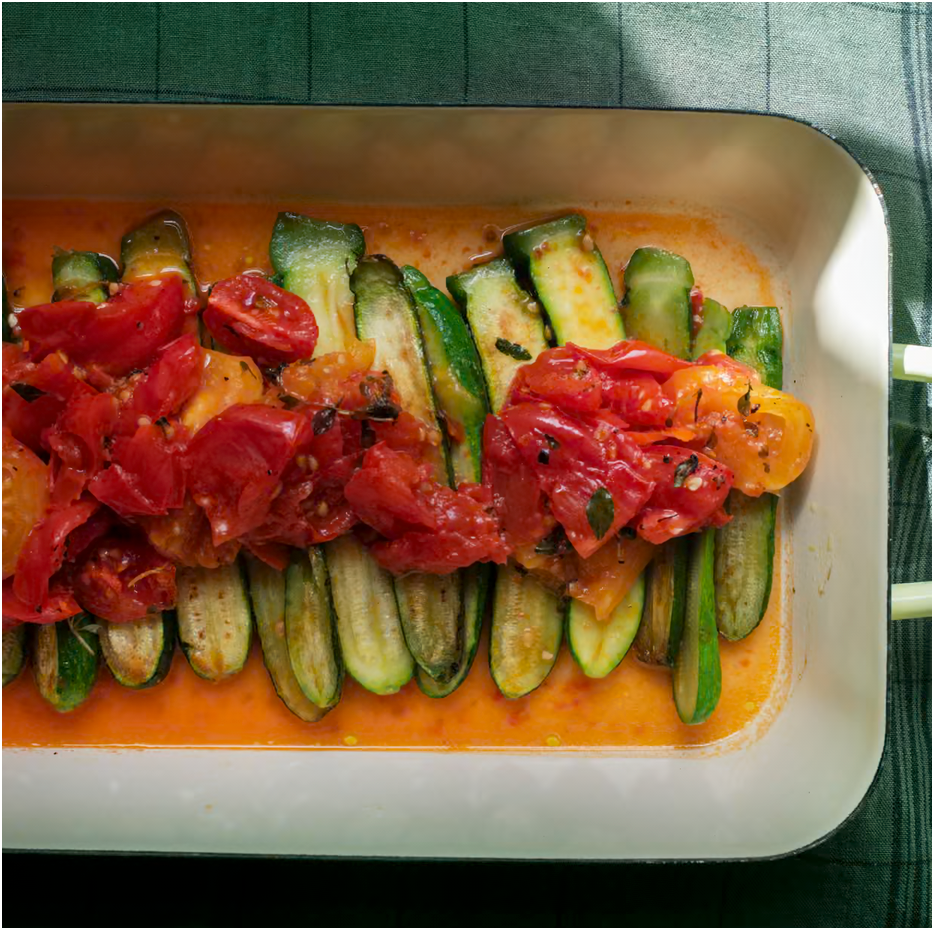
Courgettes with tomato and basil In this recipe the courgettes are simply cut in half lengthways and gently fried on both sides, lemon juice is squeezed over, before being topped with a tomato sauce - again the tomatoes have not been skinned, or seeded - they are just chopped, flavoured with garlic, chilli and thyme. But the sauce is cooked separately this time. A very minor change, but a different looking dish, although it may well have a similar taste - the difference in taste being the added garlic and chilli, and thyme not basil.

Courgettes, tomatoes and ham In this recipe the courgettes are sliced and cooked with some garlic and then set aside. Chopped tomatoes and parsley are added to the pan, cooked, seasoned and basil added, before adding the final ingredient - shredded ham - where, of course, the food snobby side of Nigel comes in because the ham has to be expensive San Daniele or Parma. Last of all the courgettes are returned to the pan.
Then you get some tiny suggestions for additions:
"I like to eat this spooned over steamed brown rice or over thick slices of toasted ciabatta. In place of the ham, I sometimes tear off pieces of mozzarella and stir them in at the last minute, so they soften in the heat of the tomato sauce."

Brown basmati, courgettes and tomatoes - so speaking of brown basmati rice he comes up with this dish. It's virtually the same but this time whilst cooking your basmati brown rice with peppercorns and bay leaves you cook the diced courgettes, this time with the different flavouring of rosemary, some sliced leeks are added and cooked, with the final addition of the chopped tomatoes and that final salt, pepper, lemon juice, before pouring over your cooked rice. A slightly more substantial dish, but again with the addition of a few ideas of how it can be varied:
"I do this sort of impromptu “stew” most often in summer. The tomatoes provide a sweet-sharp sauce to which you can add almost anything you like. Steamed French beans or broad beans; peas or pencil-thin carrots; young, steamed beetroot or small summer turnips will all work. Basil leaves are a favourite addition, as are young leaves and flowers of thyme. A scattering of mint is something to think about, as is the addition of a bunch of washed and shredded spinach at the very end."
You can almost see him standing in front of his pantry or in his garden wondering what else he could do.
Of course he is not alone in adding all the variations and little tips here and there. Even back in the day Elizabeth David did this. Today almost all cooks do - well the good ones. Nigel, however, has a knack of choosing the right words to take you into his kitchen, and to make you see that what he does is probably not all that different from what you do too. He may not always soar to exciting and hugely imaginative heights. His dishes are not trend-changing and often not even five star - but they are always at least 3 star and so beautifully written. And so darned simple.
Whether it is supper or any of those other meals, or even just a bit player in a larger offering, is probably irrelevant. The trick is that he gets you to have a go. Well I think so anyway.
YEARS GONE BY
May 26
2025 - Intangible Mexico
2024 - Nothing
2023 - Old things
2022 - An ordinary day
2021 - Missing
2020 - Missing
2019 - Nothing
2018 - Staffordshire oatcakes
2017 - Barbecued sardines


Comments