So - Robert Carrier classics
"He made making food seem a joyful art." Dennis Barker/The Guardian
In our family some of our very favourite recipes are courtesy of Robert Carrier. Possibly the collage of photographs on the left that I took for a kind of cookbook I produced of our COVID cooking classes, really demonstrates the joy that Carrier often talked about. My grandchildren are making Robert Carrier's spaghetti and meatballs from The Robert Carrier Cookbook shown here in 60s style in my copy of the book, which, as you can see is falling apart, due to overuse. Over time I think the tomato sauce has morphed into various forms - most likely depending on what tomatoes and stocks and so on are available at the time. But the meatballs are constant - a mixture of minced beef, bread soaked in milk and then squeezed and crumbled, garlic, Parmesan and lots of parsley. The meatballs are then rolled in flour and fried before cooking in the sauce. It's the dish of choice for birthday celebrations.
Second choice would be what we just call kebabs. Carrier himself is a bit vague about a name. I first found it in one of his Sunday Times articles where it appeared as part of a Dutch rijsttafel -rice table. Indeed in the Robert Carrier Cookbook it first appears in the Appetisers section as Javanese steak satés, but later on in the same book it reappears in the Summer Food and Barbecue section as California Beef Kebabs. Exactly the same recipe - and it has to be said, that he often repeated recipes in different books. It's very simple and utterly delicious. You just marinade strips of rump steak - around a kilo - in 6 tablespoons of olive oil, 2 of lemon juice and 2 of soy sauce, plus crushed garlic, a dessertspoon of powdered cumin and a chopped onion. Thread on to skewers and grill. Serve with the sauce, rice or flatbread and lots of black pepper.
The third most popular is the Christmas turkey which comes from volume 1 of his Cookery Course. The main difference here is the method - the turkey is covered with a double layer of muslin soaked in melted butter with orange juice, white wine a chopped clove of garlic and a crumbled chicken stock cube. You baste it every 20 minutes, and the turkey emerges at the end with a crispy brown skin and moist meat.
These are made on frequent repeat - well the turkey once a year but there are so many more recipes that I still make now and then, and many, many more that I have made, could easily make again, but have sort of forgotten about. Until you start flicking through his books.

I now have almost all of his books and a set of cards as well, but sadly I rarely use them. This man, however taught me to cook. Well my mother really did of course, but also Elizabeth David and Jane Grigson. However, I never failed with Robert Carrier and he was much more fun - Elizabeth David was a bit daunting as Dennis Barker put it in his obituary in The Guardian:
"While middle-class arbiters of British taste have always handed the palme d'or of postwar culinary revolution to Elizabeth David and her disciples, it was the showman, the publicist, the camp outsider Carrier who broadened the appeal of fancy foreign food and cookery into something that might be said to have been actually revolutionary - as radical, perhaps, for British mores as the contraceptive pill or the Beatles."
Paul Levy in The Independent says much the same thing:
"The upper echelons of foodiedom were always a little sniffy about Bob Carrier - authenticity was not a word that sprang immediately to their mind or his lips. But he did more to change people's attitudes to food than many a more serious-minded cookery writer, and he knew the great secret that food is fun."

For yes, he has been largely forgotten. You won't find many of his recipes online, and when you do see a reference to him it is often at least mildly derogatory. Maybe he was too successful, too gay, too flamboyant although as Dennis Barker says: "if the mandarins are loath to give him credit, just look at the sales." And the sales probably came because the books too were more lavish. Every 20 or so pages there would be four or five lavish colour plates, not necessarily depicting recipes, but, like this example of a photograph of his eponymous restaurant Carrier's down the hill from us in Islington, which in those days was a slightly dodgy area. But the rich and the famous flocked there because the food was so good. Not us - neither rich nor famous.
In spite of all the glitz and glamour that people associate with him and snide remarks about lashings of butter, cream and brandy in his recipes, most of his recipes are not actually all that complicated and largely based on French, Italian and - a little later - Moroccan classics.
So let me get back to some more Carrier recipes that turn up on our table from time to time. I should say that I have limited my 'research' to those first two books - Great dishes of the World and The Robert Carrier Cookbook and his last book New Great Dishes of the World and having just flicked through all three I can happily say that I could happily have a go at around 70-80% of the recipes in them. But today it's about the ones I know and love.

Carré de porc Provençale - I suspect my love for this one is more associated with a memorable meal that we and our university friends ate on a camping trip to France, in the local hotel in Meursault in Burgundy. I think it was a Sunday and all they had was roast pork and green beans. Both of which were garlicky and divine, and we drank a bottle of the house wine - a local Meursault to go with it. Which, of course, was also divine and I tried for ages to reproduce the pork. I think the Robert Carrier recipe was the nearest that I came to it. I must try it again soon.
Quick jambalaya - He actually has two recipes for jambalaya - the 'proper' Creole jambalaya looked a bit daunting - a long list of ingredients and so I went for his Quick version. It's one of the recipes in Great Dishes of the World that is prefaced with an actual full colour photograph and a short essay on the topic, the first paragraph of which I repeat here:

"For me, one of the most romantic places in the United States, and perhaps the world, is the shadowy, unreal swamplands of Louisiana, where the grey streamers of Spanish moss trail heavily from the branches of oak trees, removing all sense of depth and turning the bayoux into a series of dreamy backdrops for some gigantic ballet."
But I did substitute chicken for the prawns - well David you know. I suppose it's a kind of paella but slightly different in that he describes it as:
"combining the subtlety of the French, the exoticism of the Conquistadores and the earthy magic of the Negro plantation cooks."
English apple pie - and yes, this one and its companion Apple streusel are from the same set of Cookery cards - Desserts. And they are regularly made in this house. The apple pie is so special because of the rubbing into the pastry lining the pie dish of a mix of sugar, flour and orange and lemon peel - which is also sprinkled on the top of the apples and sultanas when they have filled the dish. Plus orange and lemon juice.

I guess we make the streusel more than the pie, because it's marginally simpler, but both are easy. The pie also makes a return in his last book as a 'classic', And it is so simple that a child can make it as the photo attests. A joyful COVID cooking class success - the grandaughters looked very pleased.

Irish stew - this also reappeared in his last book in the Classics section. Of course I learnt to make Irish stew from my mother, but I couldn't really remember it precisely so I had a go at his recipe. And for such a simple and basic dish - lamb, potatoes, onions, water, and herbs is all it consists of, it is so amazingly delicious. I think I might have taken his advice to:
"pop in a few sticks of carrot and celery to add illicit colour and savour to this great dish."
But yes it's a classic for a reason.

Egyptian lemon chicken - because it's so easy. This is one that my children and grandchildren have taken to. You simply marinade the chicken in olive oil, lemon rind and juice, garlic, dried thyme, salt and pepper. Then bake in a buttered dish with more butter on top and sprinkle with parsley to serve. I think it's the thyme and the butter that make this so great.

Pollo alla Romano con peperoni - Another deceptively simple dish. Chicken, browned and stewed in wine, onion, garlic and tomatoes and finished off with fried capsicum slices at the end. We have this fairly regularly, although I haven't made it for a while because of the cost of peppers this year. But they are coming down in price at last so maybe I'll do it again soon.

Baked tagliatelle with mozzarella and tomato sauce - again this is so everyday but you have to remember that I first made this way back in the 60s when mozzarella was exotic. It is what it says it is although there is Parmesan involved as well. Back then these were exotic ingredients. So were tinned tomatoes. Can you believe that? At the time I was blown away. I aim to make this soon to see how it compares with Alison Roman's baked pasta shells. The photograph is not of Robert Carrier's dish and I see that this one features cherry tomatoes. We didn't know about them back then.
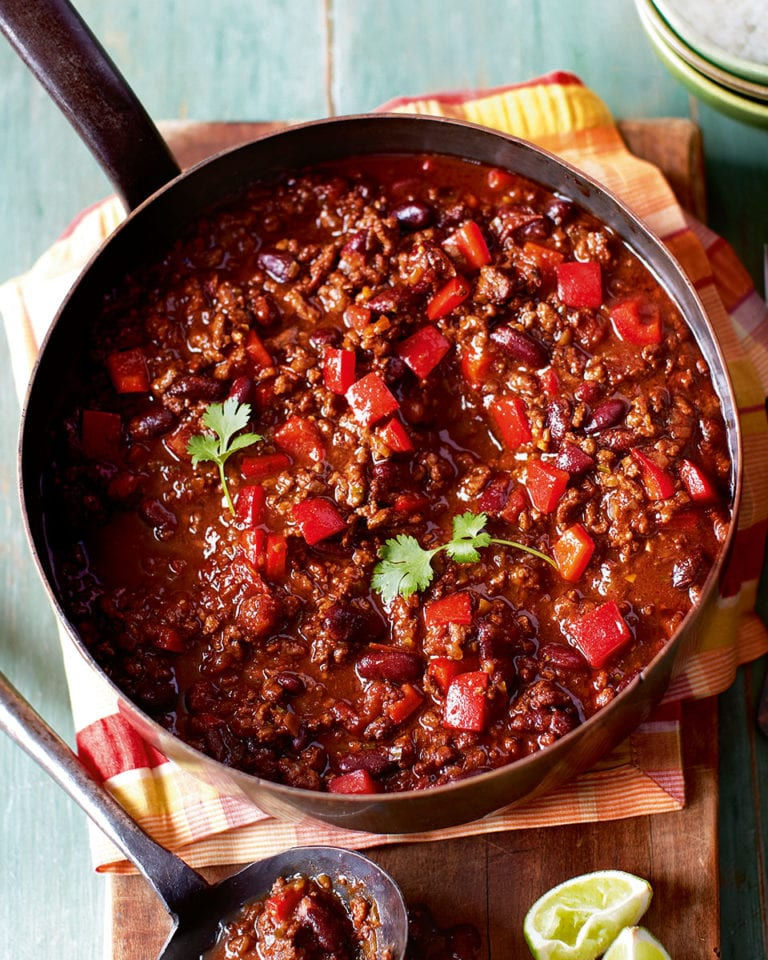
I'll end with a disaster - just to show that nobody is perfect. Chilli con carne with red wine. The recipe calls for 4 tablespoons of chilli powder. Yes you read that right. 4 tablespoons. I actually tremembered it as one, but even if it had only been one I think the result would have been the same. I can still see David lying there on our couch in our Hampstead flat almost having palpitations. Carrier included the recipe in his Classics section in New Great Dishes of the World - same amount of chilli but here he tells us that the chill in Mexico is mild, and that you should probably try with a small amount until you get the right heat. I wonder if he got a lot of complaints about the original.

Late in his life he wrote Great New Dishes of the World which included many recipes from other cooks from around the world, including several from Australia. I made a few of the dishes therein - he has a lovely but inauthentic version of pissaladière for example - but honestly the most benefit I got was from this section which he called New Basics, where I learnt to make chermoula, how to cook couscous, and infused oils, as well as a whole lot of other things that you can see listed here. It's a good summary of all the things that we take for granted now, many of which appear on our supermarket shelves. I have already demonstrated his Classics section featured several of his old recipes, including many of my own favourites. It was written in 1997. He died at the age of 82 in France in 2006.
I could feature many more recipes. He was a hero of mine. My Nigel or Ottolenghi of the day I guess. His recipes were great, surprisingly simple and he was much friendlier than Elizabeth David. Who I shall do next in my classics series. Because of course she was wonderful too but in a different way.
Oh the sixties. I remember them well:
"His was the cooking that launched a million dinner parties: the great engine of British social change during the 1960s." Dennis Barker/The Guardian
So why isn't he appreciated these days? I think virtually all of his books are out of print.
YEARS GONE BY
October 19
2025 - Nothing
2023 - A ball of string
2021 - Missing
2020 - Missing
2018 - Iceberg lettuce
2016 - Ditto for barbecued corn


Comments