Confused by trends
“Like dogs, foodies wag their tails at the slightest sniff of new and exciting. Then bark at each other on social media. Food is fashion. If you’re into that stuff, it matters.” Perry Haydon-Taylor/The Guardian

I was going to call this post two trends in one - illustrated by this Coles recipe for Fluffy Cheesecake with matcha icing sugar from their Food Director, Sarah Hobbs - the two trends being Japanese cheesecake and matcha desserts. The trends were based on the list published by Taste that I mentioned a few posts ago. Other sources I have since found, list different trends as being 'hot'
However, since then I see that I misunderstood what they meant by Japanese cheesecake for there are two different kinds of Japanese cheesecake - and both are trendy but in slightly different ways. The one that Taste was talking about was the one shown below - on the left their example from Michelle Southan - 2-ingredient lemon cheesecake in a tub and the second from Food and Wine's Merlyn Miller - the American version that uses Biscoff biscuits.

It doesn't look that wonderful does it and, indeed there are several naysayers who say things like:
"Do you like wet cookies? Then this is the dessert for you." Washington Post
What it is is yoghurt and biscuits. You put your biscuits into a tub of yoghurt, put it in the fridge for a long time - well at least 8 hours, by which time you end up with this.
The Taste people did a test of several varieties of yoghurt combined with several varieties of biscuits - We tested the viral 2-ingredient Japanese cheesecake 5 ways – and THIS was the best - Rebecca Nittolo/Michelle Southan/Taste - the best being the lemon yoghurt and Anzac biscuits version shown above on the left. They even tested a breakfast version with a raspberry yoghurt and weetabix, but Michelle Southan was not that impressed saying: "It’s very breakfasty. It needs some fresh fruit and a drizzle of honey.”

To me the whole thing looks a bit like our Chocolate ripple fridge cake - this is Helen Goh's version, that I made one Christmas. But it's got many more ingredients than two and they are not yoghurt - oodles and oodles of cream I seem to remember plus crème fraïche and various other extras - including Grand Marnier.
Tiramisù is another similar thing I reckon - or even old-fashioned trifle.
But of course you can sort of tell can you not, that this originated on TikTok? It's quick and it's snappy and many say that it tastes delicious. They think it began back in December 2025 but really became viral this January
"Although it’s hard to pinpoint exactly which recipe was the OG Japanese cheesecake, this trend dates back to December and it all emerged via #japantok on socials."
I tried to find the original but failed.
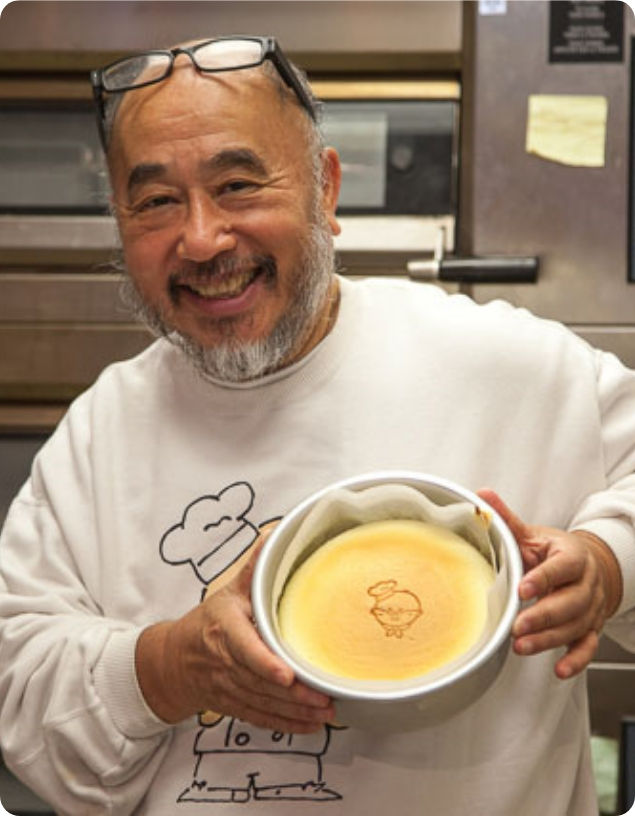
Back to what I thought was the trend that Taste was talking about - Japanese cheesecake, that does at least look like a cake and does include some cheese. Even here however the origins of the trend and the dish itself are a bit fuzzy.
This is Tetsushi Mizokami - Uncle Tetsu - who now owns bakeries around the world - including two in Melbourne. He began helping his parents in their desserts business in Fukuoku, Japan. Around 1970, in his hometown he opened the first Uncle Tetsu's and sometime in the 80s he began to make his famous cheesecake. However it was not until the 90s that the business focussed on the cheesecake.
His shops are a real drawcard. Calum Marsh from Toronto, writing in The Guardian, after a wait of ninety minutes, was not that impressed by:
"a dessert that tastes like undercooked french toast ... It’s like a sweet, soggy quiche."
However, he did have this to say about the experience:
"The question of whether something like this was worth the wait strikes me as beside the point. An hour and a half in line has a funny way of conferring upon anything an aura of significance – and an expectation that, if it can’t be fulfilled by what you’ve waited for, it is by the very act of having waited."
Which is in some way weirdly like the ambience being as important, if not more important than the food when dining out. I also thought it touched upon the way that crazes like this take hold - which was later confirmed, by UNSW Professor Nikita Garg saying that there are:
"three distinct forces at work in viral food trends: aspiration, novelty, and fear of missing out (FOMO)."
It took a long time for this trend to get going though. Wikipedia tells us that:
"The recipe was created by Japanese chef Tomotaro Kuzuno, who was inspired by a local käsekuchen cheesecake (a German variant) during a trip to Berlin in the 1960s."
Although that seems to be disproved by Nagi Maehashi's mother on the Japan Recipe Tin website saying that her recipe comes from a book she has owned from the 1940s - she even photographed it.
She also tells us that in Japan it is not called Japanese Cheesecake, but soufflé cheesecake or - simply - baked cheesecake. However she then calls her recipe Japanese cheesecake (Cotton cheesecake) - Cotton cheesecake being another common name used today - mostly in America I think. My own opinion is that all things Japanese are super trendy these days, and I'm sure there are many learned theses on why - and so calling it Japanese cheesecake gives it kudos. Well it does definitely seem to come from Japan.

So what is it that differentiates it from an ordinary cheesecake? Well it is much lighter - it looks more like a sponge than a regular baked cheesecake and Tamal Ray, in the introduction to his own Japanese pistachio cheesecake with cherries in syrup in The Guardian tells us that this happens because:
" A foam of glossy meringue is stirred through beaten egg yolks and cream cheese, and then gently baked in a bain-marie until it rises tall."
resulting in what Lee Tran Lam writing in the Sydney Morning Herald's Good Food section describes as:
"an eggy sponge that's trying to impersonate a cloud."

Kat Lieu (SBS) calls her version Cottony Japanese cheesecake which combines the cotton and Japanese names in one, and tells us that:
"When a nearly perfect Japanese cheesecake comes out of the oven, it’s an ethereal experience."
I'm not sure I'm keen on this one - too much like a sponge cake for me - and I'm definitely not keen on the last trend - matcha desserts, that Coles had merged with the Japanese cheesecake - thus giving me my theme for the day - well sort of. I did say that Coles was the gift that keeps on giving - to me anyway.

Two reasons why it's not for me. The main one is that I don't like tea much, but I definitely don't like green tea (unless it's used in perfumes and perfumed things like shampoo), but I also really don't like the green colour of all of these desserts. It all looks a bit Halloween to me. Which is kind of odd because green is perhaps my favourite colour. However, I think you'd agree that this Matcha Basque cheesecake from Coles looks truly repulsive.
The matcha craze began some time ago of course - another craze that emanates from Japan - and has apparently caused all manner of problems with supply. The producers just cannot produce enough, and are a bit hesitant to expand their plantings in case the trend does not last. They often don't after all. The same thing has happened with Greek yoghurt apparently in some parts of the world because of the 2-ingredient Japanese cheesecake thing.
But just in case you have a sweet tooth and also love matcha - either because of its taste or because you think it's healthy here are a few examples that I found from here and there: Matcha mug cake - Michelle Southan/Taste, which merges matcha with a recent craze for mug cakes; Surprise matcha balls - Lucy Nunes/Taste; Wimbledon cake - Ottolenghi/The Guardian; Pistachio and matcha cake - Nigel Slater/The Observer; Green tea icecram - Adam Liaw/delicious.; Matcha Fro-yo - Jamie Oliver - and the truly awful looking Baked matcha custard with ginger-poached pears - Emma Knowles/Gourmet Traveller
Trends happen far more quickly than they used to because of social media. It's hard for business to keep up with whatever might be required from them. In the case of Coles - and other such suppliers it's a matter of keeping an eye on what is trending and responding to those trends. Sometimes they get it right - sometimes they don't. I'm still waiting for za'atar and pomegranate molasses, for example, to appear on normal supermarket shelves, rather than more specialist stores. But well done for merging Japanese cheesecakes, albeit possibly of the wrong kind, with matcha desserts. If you added matcha to your 2-ingredient Japanese cheesecake, you could start a new craze.
YEARS GONE BY'
July 29
2024 - Ambience over tables
2023 - Chinese-American - Kung pao
2022 - The creative life - a long quote and World lasagne day - two in one day!!
2021 - Missing
2020 - Missing
2019 - Muffins - the American ones
2018 - Holiday tummy troubles
2017 - Nothing
2016 - Food and religion


Comments