Chasing culinary white whales
"It’s not until you come to make it yourself that you see what’s not written down.” Felicity Cloake

This is my culinary white whale - and I apologise for it not being one of my mother's dishes. Which is not to say that I don't make things that my mother did, and that I don't remember those dishes with all those warm and cuddly feelings the cooking world would like us to have when we think of mum's cooking - or even better - grandma's cooking. And I will come to mum and grandma later.
In the meantime - the above dish - which I have mentioned many times before, is the nearest I can find online and in all my cookbooks to the amazing beef daube full of carrots and big black olives that the wonderful Madame Perruque made for the extended family of my au pair employers in the family seat in the Jura. Somewhat ironically the recipe illustrated above is from the BBC Food website and a cook called Emily Angle and is simply called Slow cooker beef casserole. It's a very simple recipe and apart from the fact that it's cooked in a slow cooker may well be much like Madame Perruque's recipe. But even though I watched her make it, I didn't write the recipe down and although I have tried many, many times for years and years to repeat the experience, there is always something missing. But I keep on trying because as Jimi Famurewa says:
“We put these dishes on such a pedestal that the act of chasing down a particular sensation or taste becomes a culinary white whale, that you can end up becoming obsessed with. I have found the joy is in the journey of trying to get there, and maybe ultimately making your peace with it not being exactly the same.”

I don't think I have made peace with this particular white whale as yet, but maybe I should try the BBC recipe. But then again it will never be the same anyway will it? - I don't have the same olives that Madame Perruque bought in the market, the same wine, the same equipment. This is the nearest photograph I can find to the feeling of that huge old room. And although I say I watched her make it, that's not quite true - I was not there all the time. There was also the barrier of language - for Madame Perruque spoke in a Provençal dialect that was almost incomprehensible to me, even though my French was probably pretty fluent at that time. Besides to be honest, I cannot, of course, actually remember what it tasted like. The best I can hope for is a truly excellent beef stew with carrots and black olives. I assume there was red wine - but you know I couldn't say with any certainty that there was. Maybe the liquid was just water - or stock. Did she marinate the beef? What herbs did she use? ...
As regards my mother's cooking - well I watched her make these dishes every day. I helped her. I therefore knew exactly what went into all those wonderful things. The fact that I cannot repeat those dishes is down to the fact that again the equipment and the ingredients were different. Her kitchen was small and the oven was gas fired. The fat she used to cook the meat and the potatoes was most likely dripping. Moreover she cooked without recipes and so the quantities were by eye. A bit of this, a drop of that, a handful of this and a pinch of that.

In her oven there was always a dish in which sat pieces of fat left over from roasts or cut off before cooking. Different animals, different fats, all combined into a fatty amalgam which was probably extremely bad for the heart but which was delicious. A treat was to have some on toast. I don't do this, although I could. In fact I would probably have more fat to melt because I generally cut off most of the fat from any meat that has some. My mother would not have done this. The skin was not removed from the chicken, the fat from the beef or the pork and definitely not from the bacon, although the leftover fat in the pan would have been added to the dripping if it was not to be used for gravy.
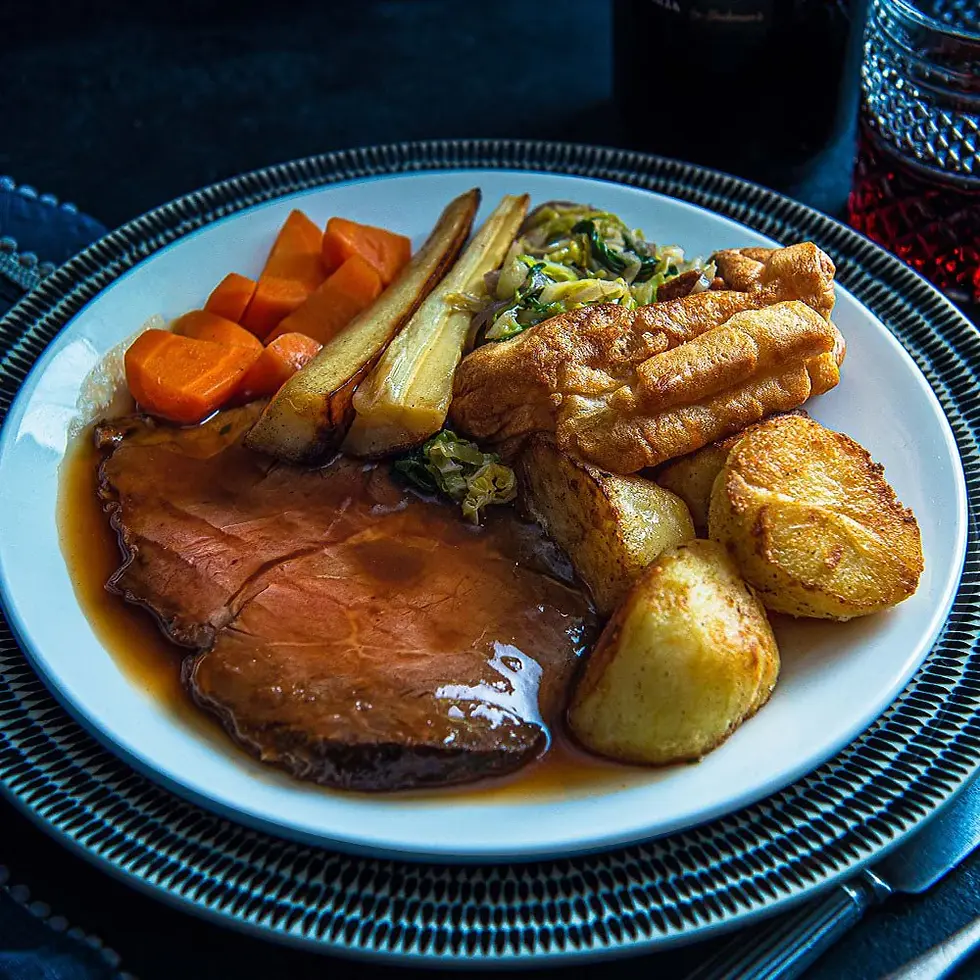
So the roast beef and Yorkshire pudding we ate - which would have looked something like this, would not have been the same as I made here. I rarely do this now, but just seeing that picture makes me think I might have another go. The beef may well have come from a different breed of cow, which anyway would have been English, not Australian. The potatoes too would have been a different variety. Even today the potatoes they quote in English recipes are not the same as those we can buy here.

Then there are the dishes that can never be the same twice - like Shepherd's pie - one of my Australian ones is shown here, complete with the baked beans and the HP sauce to accompany it - although the sauce would have been OK back then not HP. I think it was cheaper. It's a dish made from leftovers after all, and the leftovers are never the same - different meat, different leftover gravy - perhaps the most important difference - different everything really, but you still end up with something that is recognisable enough to be called by the same name because, our teachers:
“outline the key principles and offer some troubleshooting. This is often more useful than perfect, detailed guidelines. The ingredients are in charge,” Rachel Roddy
Alas Madame Perruque did not even give me the guidelines and principles. I just watched a bit - and ate it all greedily and with immense delight.

As for grandma - in England we had grandmas not nonnas or yayaias - I actually don't remember what she cooked although we spent a lot of time with her in her Portsmouth home. I'm guessing it was the same food as my mother cooked. Well my mother would have learnt from her. I remember her making things like Christmas pudding and Christmas cake, more than everyday food. I also remember - with respect to ingredients, crushing big blocks of salt into fine grains with a rolling pin for example. And she had even more different equipment - I remember she had a large stone range on which she cooked and heated her flat iron. This is a modern almost arty version I think of what she had. Take away the view of the actual stones - the stone was rendered over in some way, and there was no open fire that I can remember, but yes something like this. And so it is impossible to reproduce what she would have cooked.
Recipes were not a thing back then. You cooked what your mother had cooked. Recipe fervour was a later thing and in full swing by the time I came to be the main cook in the house. Those recipes taught me a lot - although not alas, Madame Perruque's Bœuf aux carrotes et olives noires - let's call it that. And today I am still learning new ways to cook, new cuisines, new ingredients from recipes. But I also cook from memory and from imagination, following the processes and style of my forbears. Because:
“When you cook, you are not just following a recipe. You are following a past, present and future. Dishes change according to modern times and ingredients, and to where you are in your life.” Rachel Roddy
YEARS GONE BY
May 4
2025 - Underused shallots
2024 - Spotted Dick
2022 - Trifle - no little thing
2021 - Missing
2020 - Missing
2019 - A basket of herbs
2017 - The devil's in the detail


I really enjoyed reading this because food stories and travel experiences always make cooking feel more personal and memorable. The idea of chasing special meals and unique flavors reminded me of how certain dishes can stay connected to important moments in life. During one stressful semester in college, I was balancing assignments while still trying new recipes at home, and I once used an Essay Writing Service just to keep up with deadlines. Posts like this show that food is not only about eating, but also about memories, culture, and adventure.
Family cooking made from memories. We all have them, but some of us are lucky enough to have the best food of theor lives served up to them 6 out of 7 days a week! The seventh day is fasting! 😘